What does "extra virgin" legally require?
The designation is regulated by the International Olive Council (IOC) and enforced within the EU through trade standards. In the US, USDA standards exist but are voluntary, which is why American-labelled EVOO varies more in quality. To qualify, an oil must:
- Be extracted using only mechanical means — no heat, no chemical solvents.
- Have a free fatty acid content below 0.8% (the best are under 0.3%).
- Show no off-flavours (rancid, fusty, muddy sediment) in a trained panel tasting.
What are the red flags on a label?
| LABEL SAYS | WHAT IT OFTEN MEANS | GOOD SIGN? |
|---|---|---|
| "Blend of EU olive oils" | Multiple countries, multiple crops, likely stored | ✗ No |
| "Best before" date only | No harvest date — you don't know how old it is | ✗ No |
| "Light" or "pure" olive oil | Refined with heat/chemicals — not extra virgin | ✗ No |
| Harvest date printed | Producer confident in freshness | ✓ Yes |
| Named cultivar | Single variety, traceable origin | ✓ Yes |
| DOP / PDO certification | Protected origin, independently verified | ✓ Yes |
Does the bottle color matter?
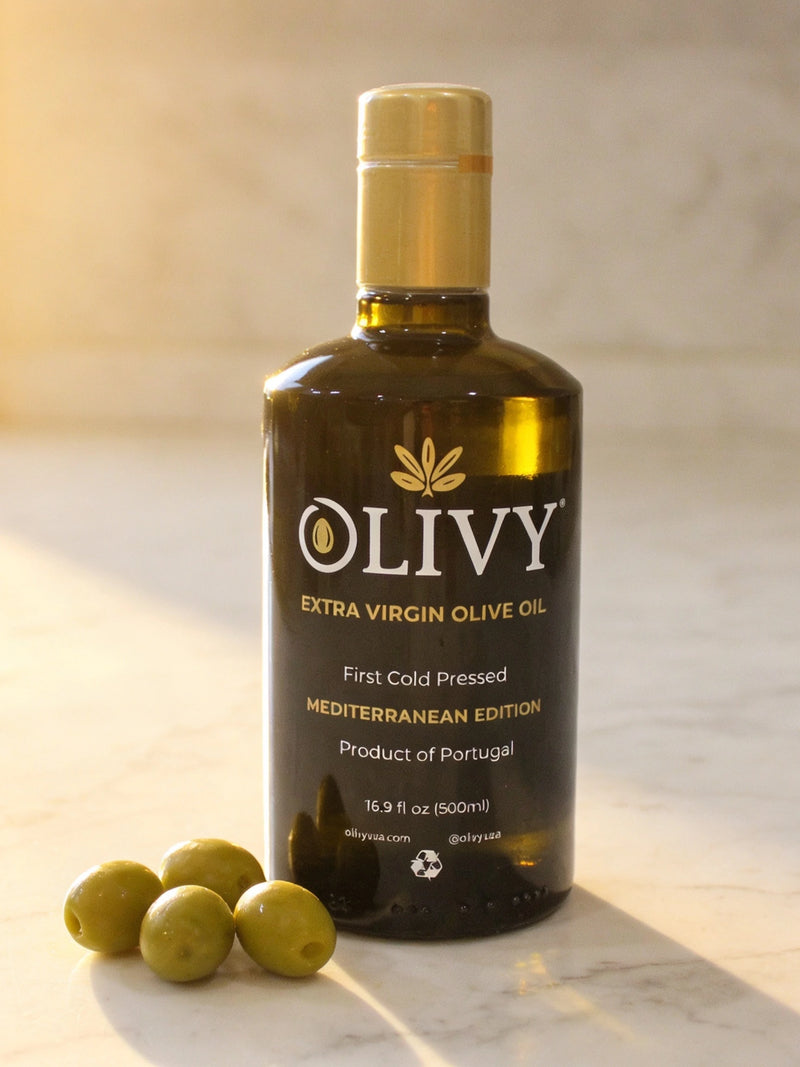
Yes. Light degrades polyphenols. Dark glass, tin, or opaque packaging extends shelf life significantly. Avoid clear glass or plastic, especially if the bottle has been sitting in a bright store display. The FDA does not regulate olive oil bottle colour, so this is entirely up to the producer's integrity.
QUICK SCAN AT THE SHELF
- Step 1: Check for harvest date
- Step 2: Look for named farm or DOP
- Step 3: Confirm dark glass or tin
- Step 4: Find the olive variety
- Step 5: Avoid "blend of EU oils"
Does "Italian" mean it was grown in Italy?
Not necessarily. "Bottled in Italy" does not mean Italian olives. Look for "100% Italian olives" or, better, a specific Denominazione d'Origine Protetta (DOP) region. The same applies to "Product of Spain" or "Product of Greece" — bottling and growing are different things.
Olivy is 100% Portuguese — grown, pressed, and bottled at the same estate, with full traceability from grove to glass.
In a 2023 study by the UC Davis Olive Center, a significant percentage of imported "extra virgin" olive oils tested failed to meet EVOO standards — showing rancidity, oxidation, or adulteration.
"Full traceability. One estate. One harvest."
SHOP OLIVY EVOO