Mediterranean Diet and Olive Oil: What the Research Actually Says

Almost everything said about the Mediterranean diet and olive oil traces back to a single trial — and that trial was retracted and republished. PREDIMED followed 7,447 Spanish adults at high cardiovascular risk and reported roughly 30% fewer major cardiovascular events in its Mediterranean-diet groups than in the low-fat control group. In 2018 the New England Journal of Medicine retracted the original paper over randomisation problems affecting about a fifth of participants, then published a reanalysis reaching broadly similar conclusions. This article is about how to read that evidence accurately: what the trial actually tested, what the reanalysis changed, and how far regulators have been willing to go.
A note on what this article is. It's a summary of published research and regulation, written for readers who want to understand the evidence rather than be told what to do with it. It is not medical or nutritional advice, and Olivy is not making any health claim about olive oil. Every outcome below is attributed to the study or regulator that produced it.
What the Mediterranean diet actually is

The phrase describes a traditional eating pattern observed around the Mediterranean basin in the mid-twentieth century — not a prescriptive plan, and not a modern invention. Its usual components:
- Vegetables, legumes, fruit, nuts and whole grains as the bulk of what's eaten
- Olive oil as the principal added fat, in place of butter, margarine or seed oils
- Fish and seafood regularly; poultry, eggs and dairy in moderation
- Red and processed meat infrequently
- Very little in the way of ultra-processed food or added sugar
- Wine with meals in some regional versions — a component researchers treat with more caution now than they once did
The word doing the work is pattern. Nutrition research has spent two decades moving away from single-nutrient thinking, and this is the clearest example of why: the components interact, and no one has isolated a single ingredient that accounts for the observed results. Anyone presenting one item as "the reason the Mediterranean diet works" has moved past what the evidence shows.
Where olive oil sits in the pattern
Olive oil is the pattern's defining fat, and in the research its role is one of substitution rather than addition.
In the traditional diet, olive oil is not poured on top of an existing way of eating. It is what vegetables are cooked in, what bread is dipped in, what fish is dressed with — occupying the place butter or lard occupies elsewhere. That distinction matters for how the studies read: the mechanisms researchers have proposed depend on olive oil displacing saturated fat rather than being consumed alongside it.
It also explains the quantities involved. In PREDIMED, the extra-virgin olive oil group was supplied with roughly a litre a week for the household, and participants were encouraged toward about four tablespoons a day — a large amount by American standards, unremarkable in a household where olive oil is the only fat in the kitchen. How that compares with typical intake is covered in how much EVOO should you eat daily.
PREDIMED: the trial, and its retraction
PREDIMED — Prevención con Dieta Mediterránea — is the study nearly every claim in this area traces back to, so it is worth understanding properly rather than through a headline.
The design
Researchers recruited 7,447 adults in Spain who were at high cardiovascular risk but had not yet had a cardiovascular event. Participants were assigned to one of three groups: a Mediterranean diet supplemented with extra virgin olive oil, a Mediterranean diet supplemented with mixed nuts, or a control group advised to reduce dietary fat. The primary endpoint was a composite of major cardiovascular events — heart attack, stroke, and cardiovascular death.
The reported finding
Both Mediterranean-diet groups showed a lower incidence of major cardiovascular events than the low-fat control group, on the order of 30% fewer events in relative terms.
The retraction
In 2018 the New England Journal of Medicine retracted the original 2013 paper and published a reanalysis. The reason was randomisation: irregularities affected roughly 1,588 of the 7,447 participants, about 21% of the trial. At one site, whole clinics had been allocated rather than individual patients; elsewhere, household members of enrolled participants were included without separate randomisation, and randomisation tables appear to have been used inconsistently.
The authors reanalysed the data with those participants handled appropriately. The republished results were broadly similar to the original. What changed was the strength of the language: the republication is more careful about describing an association rather than a demonstrated causal effect. That distinction is not a technicality — it is the difference between "this diet caused fewer events" and "people on this diet had fewer events."
How to read a finding like this
Four things are worth carrying whenever you meet the 30% figure, none of which amounts to dismissing the trial. They are also a decent general-purpose kit for reading nutrition headlines.
- Relative is not absolute. A 30% relative reduction is not a 30% drop in anyone's personal risk. When the underlying event rate is low, a large-sounding relative figure can represent a small change in absolute terms. Headlines almost always report the relative number because it is bigger.
- Who was studied matters. The participants were Spanish adults already at high cardiovascular risk. Findings in a high-risk group don't automatically transfer to a healthy 35-year-old, and the trial was never designed to test that.
- What it was compared against matters. The comparison was a low-fat diet, not an average modern diet. "Better than the control arm" is a narrower statement than "good for you."
- The intervention was the whole pattern. Two arms improved — one supplemented with olive oil, one with nuts. That is itself evidence that no single food is carrying the result.
The reasonable summary: PREDIMED is real evidence, it survived a serious methodological correction, and it supports a dietary pattern rather than any product. Related literature is surveyed in olive oil and heart health.
What regulators have actually authorised
Regulators are more conservative than headlines, and the gap between the two is informative.
In the European Union, exactly one health claim is authorised for olive oil polyphenols under Commission Regulation (EU) No 432/2012: that they "contribute to the protection of blood lipids from oxidative stress." It may be used only for oils containing at least 5 mg of hydroxytyrosol and its derivatives per 20 g of oil, and the consumer must be told the effect relates to a daily intake of 20 g. That is the entire authorised scope — nothing about heart disease, inflammation or longevity.
In the United States, the FDA permits a qualified health claim, and the qualifying language is not decoration. The authorised structure reads:
Supportive but not conclusive scientific evidence suggests that eating about 2 tablespoons (23 g) of olive oil daily may reduce the risk of coronary heart disease due to the monounsaturated fat in olive oil. To achieve this possible benefit, olive oil is to replace a similar amount of saturated fat and not increase the total number of calories you eat in a day.
We quote it in full deliberately, because reading the whole sentence is the point. Note what it concedes: "supportive but not conclusive." "May reduce." And a condition — replacement of saturated fat without adding calories — that marketing quietly drops. A brand that shortens this into "olive oil is good for your heart" hasn't summarised the claim; it has changed it into something the FDA didn't authorise. That is also why you won't find that sentence on our product pages: it belongs in an article explaining the evidence, not on a label.
Does the type of olive oil matter to the research?

Here we have an obvious commercial interest, so we're going to be exact about what can and can't be said.
What the record shows: PREDIMED specifically supplied extra virgin olive oil, not refined or "light" olive oil. That is a documented feature of the trial design. It matters because refining strips out nearly all phenolic content — the compounds the EU's authorised claim is written about. An oil with negligible polyphenols is not the same input the trial used, whatever its fat profile.
What nobody has shown: that a 439 mg/kg oil produces better outcomes than a 250 mg/kg one. No trial has compared health outcomes across phenolic levels at that resolution. A mechanism is plausible; the outcome data does not exist. We would rather say so than imply a dose-response nobody has demonstrated — and if you see a producer implying one, that is the question to ask them.
Two practical notes that are about cooking rather than health. Phenolic compounds degrade with heat, which is part of why the traditional pattern uses olive oil raw so often — over vegetables, on bread, finishing a dish. And they degrade with light, heat and time in the bottle, so a fresh, well-stored oil is closer to what was studied than an old one; the mechanics are in how to store olive oil so it doesn't go rancid.
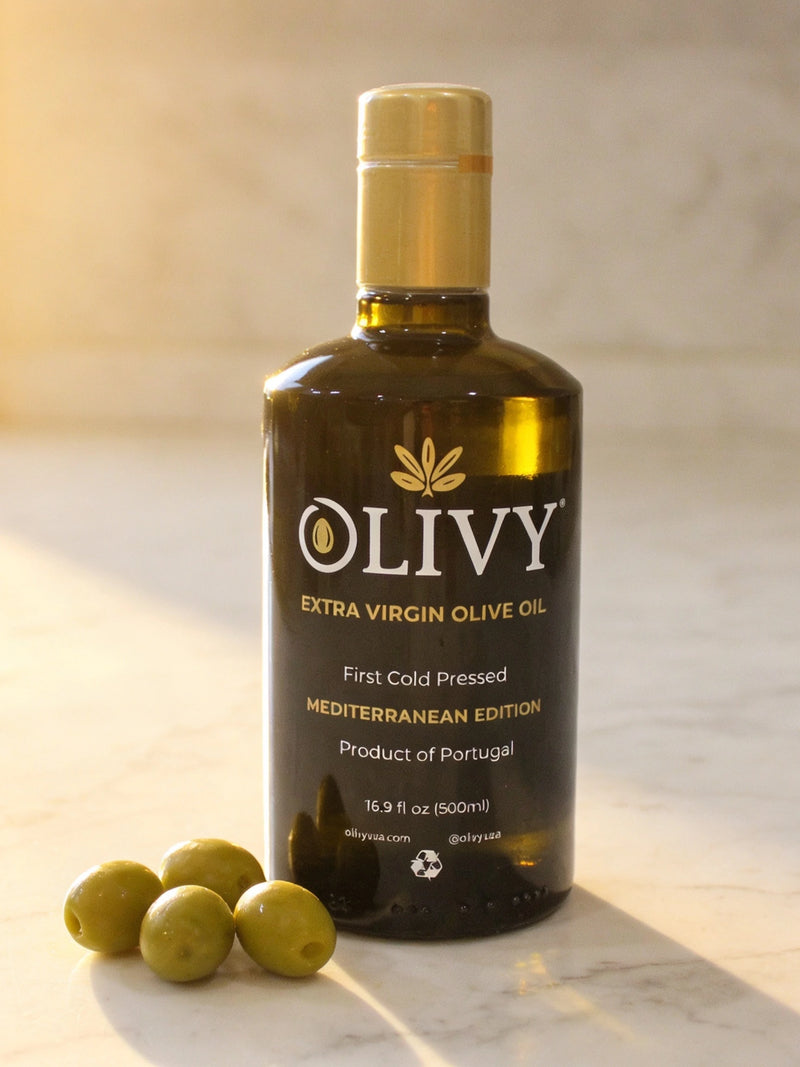
Our own Mediterranean Edition is early-harvest, single-origin from the PDO Trás-os-Montes region of northern Portugal, independently analysed by the Laboratório de Estudos Técnicos at the Instituto Superior de Agronomia, University of Lisbon. The current harvest reads 439 mg/kg total polyphenols, 0.11% free acidity and 6.2 meq/kg peroxide value, and the full report is on our proof page with its batch number. That tells you what is in the bottle. It does not tell you what will happen in your body, and we are not going to pretend otherwise. What "Mediterranean" should mean on a label is a separate question, taken up in what makes a true Mediterranean olive oil.
How we sourced this article
This is a topic where a lot of confident nonsense circulates, so here is exactly where each statement above comes from.
- The trial design, the 7,447 figure and the ~30% result come from the republished 2018 NEJM paper by Estruch and colleagues, linked below.
- The retraction details — the 1,588 affected participants and the three specific randomisation failures — come from the NEJM retraction and republication notice, and from the Harvard T.H. Chan School of Public Health's summary, both linked below.
- The EU and FDA claim language is quoted directly from Commission Regulation (EU) No 432/2012 and the FDA's own qualified health claim announcement. Neither is paraphrased.
- Every Olivy figure comes from the independent laboratory analysis published in full on our proof page, with its batch number.
- Where the evidence doesn't exist, we say so rather than filling the gap — most importantly on whether higher polyphenol levels produce better outcomes, where no comparative trial exists.
Written and researched by the Olivy team. We're olive oil producers, not clinicians or nutrition scientists — so this article reports what the published research and the regulations say, and stops there.
Frequently asked questions
How much olive oil is in the Mediterranean diet?
In the PREDIMED trial, participants in the extra virgin olive oil group were supplied roughly a litre per week for the household and encouraged toward about four tablespoons a day. Traditional Mediterranean eating uses olive oil as the only significant added fat, so intake is naturally high. The FDA's qualified health claim refers to about two tablespoons daily, replacing a similar amount of saturated fat.
Is the PREDIMED study reliable after being retracted?
It was retracted and republished in 2018 because randomisation irregularities affected about 1,588 of its 7,447 participants. The authors reanalysed the data handling those participants appropriately, and the republished results were broadly similar to the original, though described more cautiously as an association. It remains the largest trial in the field and is generally treated as meaningful evidence with acknowledged limitations rather than as discredited.
Why does the difference between relative and absolute risk matter?
Because a 30% relative reduction is not a 30% reduction in any individual's risk. When the underlying rate of events is low, a large relative figure can correspond to a small absolute difference. Headlines tend to report relative figures because they sound more dramatic, so checking which one is being quoted is a useful habit when reading any nutrition study.
Did the trial test extra virgin olive oil specifically?
Yes. PREDIMED supplied extra virgin olive oil, not refined or light olive oil, and refining removes nearly all of the phenolic compounds that the EU's authorised polyphenol claim concerns. There is no trial evidence comparing outcomes between extra virgin oils at different polyphenol levels, so a higher figure cannot be said to deliver proportionally more benefit.
Can olive oil alone reproduce the trial's results?
The evidence does not support that. Both the olive oil arm and the mixed nuts arm of PREDIMED showed lower event rates, which suggests the dietary pattern rather than any single food accounts for the finding. Olive oil's role in the pattern is as a substitute for saturated fats, within a diet built largely on vegetables, legumes, whole grains and fish.
What health claims about olive oil are actually authorised?
In the EU, one: that olive oil polyphenols contribute to the protection of blood lipids from oxidative stress, for oils containing at least 5 mg of hydroxytyrosol and derivatives per 20 g. In the US, the FDA permits a qualified claim which must carry its full qualifying language, including the phrase "supportive but not conclusive scientific evidence suggests" and the condition that the oil replaces saturated fat without increasing total calories.
Written by The Olivy Kitchen. Every claim here ties to a published lab report or a cited source.
This article describes published research and regulation for general interest and isn't medical or nutritional advice. Olivy makes no health claim about olive oil. For guidance about your own diet or health, talk to your doctor or a registered dietitian.
The research is about a pattern, not a bottle — but if olive oil is going to be the fat in your kitchen, it is worth knowing what's in it. Every Olivy harvest's full lab panel is public, batch numbers included, and the Mediterranean Edition is single-origin from PDO Trás-os-Montes.
Sources
- Retraction and Republication: Primary Prevention of Cardiovascular Disease with a Mediterranean Diet — New England Journal of Medicine (2018)
- Estruch et al., "Primary Prevention of Cardiovascular Disease with a Mediterranean Diet Supplemented with Extra-Virgin Olive Oil or Nuts," NEJM (2018, republished)
- Harvard T.H. Chan School of Public Health — PREDIMED retraction and republication
- Commission Regulation (EU) No 432/2012 — authorised health claim for olive oil polyphenols
- FDA — qualified health claim for oleic acid and coronary heart disease
- Olivy — published lab reports (439 mg/kg polyphenols, 0.11% acidity, 6.2 meq/kg peroxide, University of Lisbon)