How to Store Olive Oil So It Doesn't Go Rancid

How to store olive oil so it doesn't go rancid: keep it in a closed cupboard away from the stove, in dark glass or tin, with the cap on tight, and finish it within a few months of opening. Four things degrade olive oil — light, heat, oxygen and time — and light is the most aggressive of them. Extra virgin olive oil is generally at its best within roughly 12 to 18 months of harvest under good conditions, and that clock starts at the harvest date, not the day you bought it. Below: what each factor actually does, the best and worst spots in a normal kitchen, and the storage advice that turns out to be a myth.
What "rancid" actually means
Rancidity is not spoilage in the way milk spoils. Olive oil does not grow bacteria or become unsafe in the ordinary sense. What happens is oxidation: oxygen attacks the fatty acids, and the products of that reaction taste and smell wrong.
The process runs in two stages. First, oxygen forms compounds called hydroperoxides — this is the phase a lab measures as peroxide value. Those compounds are unstable, and as they break down they produce the aldehydes and ketones responsible for the actual smell of rancid oil: stale nuts, old putty, wax crayons, a faint cardboard note. By the time you can smell it, oxidation has been running for a while. The chemistry behind the measurement is in what peroxide value actually tells you.
Two useful consequences. Rancid oil will not make you ill — it will make your food taste of cardboard, which is its own kind of loss when you have paid for a good bottle. And rancidity is gradual, not a switch: an oil is a little further along every month, which is why storage is worth getting right rather than worrying about a use-by date.
The four things that ruin olive oil

1. Light — the worst of the four
Light drives oxidation directly and fast, and it is the factor most people ignore because a bottle on the counter looks good. This is the entire reason dark glass and tin exist. A clear bottle on a sunlit windowsill can lose meaningful quality in weeks. Storage research comparing containers consistently finds that light-excluding packaging preserves oil markedly better than clear glass across a shelf life.
2. Heat
Oxidation is a chemical reaction, and reactions accelerate as temperature rises. Storage trials on extra virgin olive oil find that cooler storage retains substantially more phenolic content over 12 to 18 months than warm room temperature does. In practice this makes the cupboard you choose more consequential than the brand you buy — and it makes the shelf above the stove, which is where a great many people keep their oil, close to the worst option in the room.
3. Oxygen
Every time the bottle is opened, fresh air reaches the oil, and the empty space above the oil is a reservoir of oxygen working on it continuously. This is why a bottle ages faster as it empties: the last third has far more air sitting on it than the first third did. A tight cap matters more than it sounds.
4. Time
Even stored perfectly, olive oil declines from the day it was pressed. Phenolic compounds — the antioxidants that give a fresh oil its peppery bite and also protect it from within — are consumed as they do that protecting. An oil with a high phenolic count starts with more of its own defence, which is one of the practical arguments in are high-polyphenol olive oils worth it.
Where and how to store olive oil in a real kitchen
The ideal is a closed cupboard, on an interior wall, away from any heat source, at ordinary cool room temperature. That is it. No special equipment.
| Spot | Verdict | Why |
|---|---|---|
| Closed cupboard away from the oven | Best | Dark, stable temperature, no direct heat |
| Pantry or cellar | Best | Same, usually cooler still |
| Counter, out of direct sun, in dark glass | Acceptable | Convenient; fine if you use the bottle within a couple of months |
| Next to the hob or above the stove | Avoid | Repeated heating cycles every time you cook |
| On a windowsill or under a spotlight | Avoid | Direct light is the fastest degrader of all |
| On top of the fridge | Avoid | Warm air vents there; it is one of the hottest surfaces in a kitchen |
One realistic compromise, since nobody wants to walk to a pantry mid-recipe: keep the main bottle in the cupboard and decant a small working amount into a dark cruet on the counter, refilling it every week or two. The bulk of the oil stays protected and the part you are actively using never sits out long enough to matter.
Containers: dark glass, tin, and what to avoid
- Dark glass — the standard for good reason. Blocks most light, inert, doesn't interact with the oil, and lets you see the level.
- Tin — excellent, blocks light completely. Common for larger formats. The trade-off is that you cannot see how much is left.
- Stainless steel fusti — what producers use; ideal but rarely practical at home.
- Clear glass — avoid where you can. If a good oil arrives in it, keep it in a closed cupboard or a paper sleeve.
- Plastic — the weakest option for anything you plan to keep. Fine for immediate use, not for storage.
- Decorative open cruets — an open pouring spout means continuous air contact. Use one for a week's worth, not as the storage vessel.
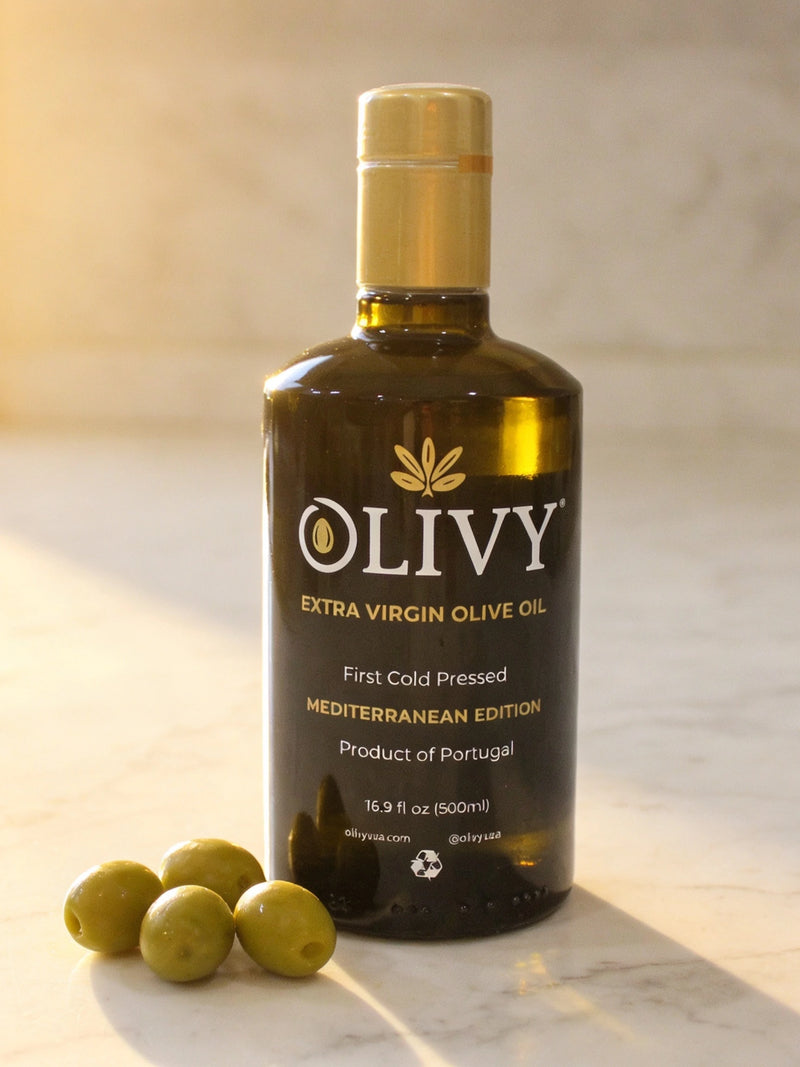
Our own Mediterranean Edition ships in dark glass for exactly this reason — it is part of why the current harvest's peroxide value comes in at 6.2 meq/kg against a 20 meq/kg limit, alongside 0.11% free acidity, on the report published on our proof page. Packaging is not a detail on the outside of the product; it is one of the variables that determines what is inside it by the time you pour.
Should you refrigerate olive oil?
Generally, no — and the reasoning is worth understanding because a persistent myth is attached to it.
Refrigeration will not harm the oil. It slows oxidation, and for a bottle you expect to keep unusually long it does no damage. But it is unnecessary for normal use, the oil turns cloudy and semi-solid and needs time on the counter before it pours, and repeated cooling and warming can cause condensation inside the bottle, which introduces water. A cool cupboard achieves most of the benefit with none of the inconvenience.
The myth worth retiring separately: chilling olive oil is not a purity test. Whether an oil solidifies in the fridge, and how fast, depends on its fatty-acid composition and the temperature — not on whether it is genuine extra virgin. Both real and adulterated oils can thicken, and both can stay liquid. It tells you nothing about authenticity. The checks that do work are on the label and in the paperwork, and they are set out in how to read an olive oil label and spot a fake.
How long olive oil actually lasts

Two different clocks, and confusing them is the usual mistake.
From harvest. Extra virgin olive oil is generally considered at its best within about 12 to 18 months of pressing under good storage. The harvest date is the number that matters, and it is not the same as the best-before date, which is typically set a fixed period after bottling and can sit two years past the pressing.
From opening. Once opened, aim to finish a bottle within roughly one to three months. Not because it becomes unusable, but because that is the window in which you are getting what you paid for — the aromatics and the peppery finish fade first.
The practical consequence is about bottle size rather than storage technique. A large-format tin is only good value if your household actually gets through it in a few months. For most people a 500 ml bottle finished briskly beats a bargain three-litre tin that goes flat at the halfway mark. And when you are buying, harvest date beats every other signal on the label — the case for which is in three secrets to finding fresh EVOO.
How to tell if yours has already turned
Your nose is a better instrument than any date printed on the bottle. Pour a little into a glass, warm it in your palm, and smell.
- Fresh oil smells green — cut grass, green tomato, artichoke, almond — and finishes with a catch at the back of the throat.
- Rancid oil smells of stale nuts, old putty, wax crayons or cardboard, and tastes flat and greasy with no pepper at the finish.
- Fusty or winey notes — a sour, vinegary or muddy smell — point to fruit that fermented before pressing rather than to bad storage at home.
A useful calibration trick: the flavour most people think of as "normal olive oil" is often a mildly rancid one, because that is what a long supply chain produces. Tasting a genuinely fresh oil beside an old one recalibrates the reference point quickly. The structured version of this method is in how to evaluate EVOO like a professional.
If a bottle has turned, it is not dangerous — but it will flatten everything you put it on. Use it up on something forgiving, and store the next one in the cupboard.
Frequently asked questions
What is the best way to store olive oil?
In a closed cupboard away from the oven and any direct light, in dark glass or tin, with the cap sealed tightly, at ordinary cool room temperature. Avoid the shelf above the stove, the top of the fridge, and sunny windowsills. If you want a bottle within reach while cooking, decant a small working amount into a dark cruet and keep the main bottle stored.
Does olive oil go bad?
It goes rancid rather than unsafe. Oxygen reacts with the fatty acids over time, producing compounds that smell and taste of stale nuts, putty or cardboard. Rancid olive oil will not make you ill, but it loses its aroma, its peppery finish and much of its character, so it is worth avoiding for the sake of the food rather than for safety.
How long does olive oil last after opening?
Aim to finish an opened bottle within roughly one to three months. It remains usable well beyond that, but the aromatics and pungency fade first, so the qualities you paid for are the ones you lose earliest. Buying a bottle size your household will actually get through in that window matters more than any storage technique.
Should olive oil be refrigerated?
Not for normal use. Refrigeration slows oxidation and does no harm, but the oil turns cloudy and semi-solid, needs time to pour, and repeated cooling and warming can create condensation inside the bottle. A cool, dark cupboard gives you most of the benefit without the inconvenience.
Does olive oil solidifying in the fridge prove it's real?
No. Whether an oil thickens or solidifies when chilled depends on its fatty-acid composition and the temperature, not on whether it is genuine extra virgin. Real oils can stay liquid and adulterated oils can solidify, so the fridge test is not a purity test. Reliable checks are the harvest date, the grade, the origin, and whether a lab report exists for the batch.
Is it bad to keep olive oil next to the stove?
Yes, it is one of the worst spots in a kitchen. The oil is heated a little every time you cook, and repeated warming accelerates oxidation. It also tends to be a well-lit position. Convenience is real, so if you want oil at the hob, keep a small amount there and store the bulk of the bottle elsewhere.
Written by The Olivy Kitchen. Every claim here ties to a published lab report or a cited source.
Good storage protects what an oil started with — so it helps to know what that was. Every Olivy harvest's full lab panel is public, batch numbers included, and the Mediterranean Edition ships in dark glass with the harvest on the label.
Sources
- Effect of containers on the quality of Chemlali olive oil during storage — Journal of Food Science and Technology
- Impact of Extra-Virgin Olive Oil Storage Conditions on Phenolic Content
- Storage Stability of Virgin Olive Oil: Evolution of Quality Parameters and Phenolic Compounds under Different Conservation Conditions
- International Olive Council — trade standard applying to olive oils
- Olivy — published lab reports (6.2 meq/kg peroxide value, 0.11% acidity, University of Lisbon)