Oleocanthal: The Olive Oil Compound That Acts Like Ibuprofen

Oleocanthal is the phenolic compound in extra virgin olive oil that causes the peppery sting at the back of your throat. It got its name from that sting, and it is the reason a fresh, well-made oil makes you cough while a tired one slides past unnoticed. It is also the subject of a much-repeated piece of science: in 2005, researchers reported in Nature that oleocanthal inhibits the same COX enzymes as ibuprofen in laboratory tests. That finding is real, and it is routinely stretched further than the researchers took it. Below: what oleocanthal is, why it stings only your throat, exactly what the studies reported, and how to taste it in a bottle you already own.
A note on what this article is. It's a piece about flavour chemistry — what a compound is, why it tastes the way it does, and what published researchers reported about it. It is not health guidance, and Olivy is not making any health claim about olive oil here. Where studies are described, they're attributed to the specific paper, with the limits the authors themselves stated.
What is oleocanthal?

Oleocanthal is one of the phenolic compounds olives produce naturally, and a fraction of it carries over into the oil when the fruit is crushed. Chemically it sits in the same family as oleuropein and hydroxytyrosol — the group that lab reports and regulations refer to collectively as biophenols.
The name is a description rather than a tradition. It was coined from oleo for olive, canth for sting, and -al for the aldehyde group in its structure. Olive-sting-aldehyde. Few compounds are named quite so literally after what they do to you.
It is worth being clear how oleocanthal sits inside the broader polyphenol picture, because the terms get used loosely. Total polyphenols is the umbrella figure you see on a lab report — ours reads 439 mg/kg. Oleocanthal is one contributor inside that total, and it is not itemised separately on a standard panel. So an oil with a high total phenolic count is likely to carry meaningful oleocanthal, but the report does not tell you how much. What the total figure does and doesn't cover is set out in are high-polyphenol olive oils worth it.
The discovery: a sensory accident
The compound was identified because someone noticed a coincidence and took it seriously.
Gary Beauchamp, a researcher at the Monell Chemical Senses Center in Philadelphia, tasted a peppery Sicilian olive oil and recognised the throat irritation. He had felt something very similar before — not from food, but from liquid ibuprofen encountered while working on the sensory properties of cold medicines. Two unrelated substances producing an unusually specific sensation in the same unusual place suggested they might be acting on the same target.
The resulting work was published as "Ibuprofen-like activity in extra-virgin olive oil" in Nature in 2005. It named the compound oleocanthal and reported that, in laboratory assays, it inhibits the cyclooxygenase enzymes COX-1 and COX-2 in a dose-dependent way, as ibuprofen does. Neither compound resembles the other structurally. They simply act on the same enzymes.
It is a good story about how science sometimes works — a chance sensory observation turning into a chemical identification. That is the part of it we find genuinely interesting, and it is separate from any question about what olive oil does in a person.
Why oleocanthal stings only your throat
Most pungent foods announce themselves across the whole mouth. Chilli burns the tongue, the lips, the palate. Oleocanthal does almost nothing there and then catches sharply at the back of the throat, sometimes hard enough to make you cough.
That oddity was explained in a 2011 paper in the Journal of Neuroscience by Peyrot des Gachons and colleagues. Oleocanthal is highly selective: it activates a single sensory receptor, TRPA1. And TRPA1, within the oral cavity, is anatomically concentrated in the pharynx rather than distributed across the tongue. A compound that triggers one receptor, and a receptor that sits in one place, produces a sensation in only one place.
The same paper noted that ibuprofen, which produces the same restricted throat irritation, also excites sensory neurons via TRPA1. The sensory coincidence that started the investigation turned out to have a shared mechanism behind it.
The practical upshot at a kitchen counter: that cough is not a defect, and it is not the oil being "too strong." It is a reasonably direct sensory readout of phenolic content — which is why it belongs on a tasting sheet rather than in a medicine cabinet.
What the researchers reported — and the limits they stated
This is where the topic usually goes wrong, so it is worth separating carefully. Each item below is what a specific paper reported, not a claim we are making about our oil.
What was demonstrated, and where. Beauchamp and colleagues reported that oleocanthal inhibits COX-1 and COX-2 in laboratory assays, with potency broadly comparable to ibuprofen in the same tests. That is a biochemical result obtained in vitro. It is not a finding about people eating olive oil.
The scale, in the authors' own terms. The Nature paper put the quantity plainly: roughly 50 g of extra virgin olive oil — about three and a half tablespoons — supplies an amount of oleocanthal whose COX-inhibiting activity in those assays corresponds to approximately 10% of a standard adult ibuprofen dose. Ten percent, from a quantity of oil most people would not consume in a day. The comparison is a measure of scale, not of equivalence.
What nobody has shown. No clinical trial has established that eating olive oil produces a therapeutic effect through oleocanthal. Olive oil is not a medicine, is not a substitute for one, and nothing in this literature supports using it to treat or manage anything. If you are dealing with pain or inflammation, that is a conversation for a clinician, not a question about which oil to buy.
What regulators have been willing to authorise. Worth knowing, because it shows how cautious the official position is. The single health claim European regulators have authorised for olive oil polyphenols, under Commission Regulation (EU) No 432/2012, concerns the protection of blood lipids from oxidative stress, for oils meeting a defined threshold. Oleocanthal and inflammation are not part of that authorisation — no regulator has approved a claim in that area. We treat the gap between the headlines and the authorisation as the honest summary of where things stand.
Our own position is simple: oleocanthal is interesting because it explains a flavour and signals freshness. That is what we will say about it. Anything beyond that is not ours to claim.
What makes an oil high in oleocanthal
The same things that drive total phenolic content, because oleocanthal moves with the family.
- Harvest timing. The largest single factor. Green, unripe olives carry far more phenolic content than fully ripened fruit. Early harvest yields less oil per tree and more of what you are paying for.
- Variety and growing conditions. Cultivar matters, and so does stress — altitude, drought and sun exposure all push trees to produce more defensive compounds.
- Speed from tree to mill. Fruit milled within hours retains substantially more than fruit that sat in bins.
- Freshness and storage. Phenolics decline from the day of pressing, accelerated by light, heat and oxygen. An oil that was high in oleocanthal at bottling will not be two years later on a bright shelf — which is why harvest date and dark glass matter as much as the original number. The mechanics are in what peroxide value actually tells you.
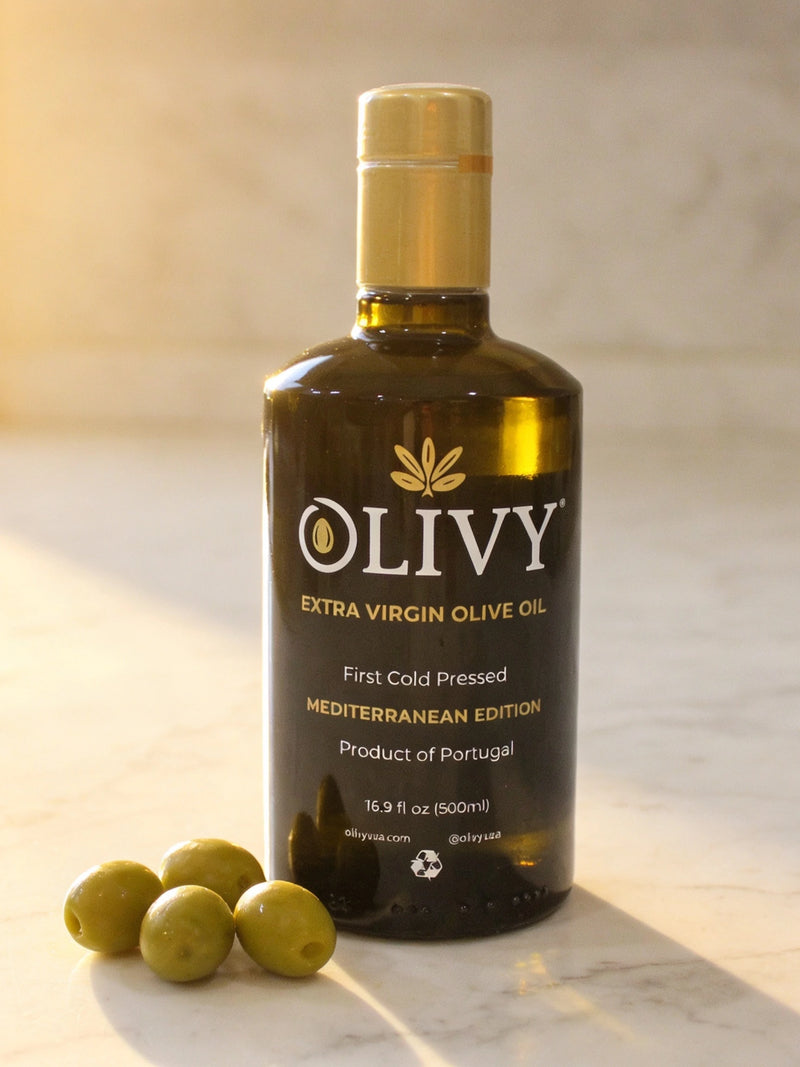
Our own oil is early-harvest, single-origin from the PDO Trás-os-Montes region of northern Portugal, milled within hours and bottled in dark glass. The current harvest of the Mediterranean Edition tests at 439 mg/kg total polyphenols, independently analysed by the Laboratório de Estudos Técnicos at the Instituto Superior de Agronomia, University of Lisbon, with the full report published on our proof page. To be precise about what that shows: it is a total phenolic figure, not an oleocanthal measurement. We would rather say that plainly than imply a number we do not have.
How to tell whether your oil has any

You cannot taste a milligram figure. You can taste whether one is plausible, and it takes about a minute.
- Pour a teaspoon into a small glass.
- Cup it in your palm and cover the top with your other hand for thirty seconds — warming it releases the aromatics.
- Uncover, smell, then sip a small amount and draw air across it through your teeth.
- Swallow, and wait a few seconds. Pay attention to the back of your throat, not your tongue.
A distinct catch or tickle arriving a beat after you swallow indicates oleocanthal is present. Among enthusiasts the informal shorthand is counting coughs — a one-cough or two-cough oil — which is a rough sensory impression rather than anything quantitative, but it tracks the right variable. If nothing happens at all, there is not much phenolic content there, whatever the label says. The full structured method, including how to screen for defects, is in how to evaluate EVOO like a professional.
This is the part of the subject that is actually useful in a kitchen. A cough tells you the oil in front of you is fresh and phenol-rich. It doesn't tell you anything about your health, and it isn't trying to.
How we sourced this article
Because this topic attracts a lot of loose claims, here is exactly where the statements above come from, so you can check them rather than take our word for it.
- The COX finding and the 50 g comparison come from the original 2005 Nature paper by Beauchamp and colleagues, linked in full below. We have described it as an in-vitro result because that is what it is.
- The TRPA1 explanation for the throat sting comes from the 2011 Journal of Neuroscience paper by Peyrot des Gachons and colleagues, also linked below.
- The regulatory position is quoted from Commission Regulation (EU) No 432/2012 directly.
- Every Olivy figure — 439 mg/kg total polyphenols, the harvest, the laboratory — comes from the independent analysis published in full on our proof page, with its batch number, not from our marketing.
- Where we don't have a number, we say so rather than estimating. We do not publish an oleocanthal measurement, so we have not implied one.
Written and researched by the Olivy team. We're olive oil producers, not clinicians — so this article reports what the published research says and stops there.
Frequently asked questions
What is oleocanthal in olive oil?
Oleocanthal is a phenolic compound found in extra virgin olive oil, responsible for the peppery irritation felt at the back of the throat. Its name combines the roots for olive, sting, and aldehyde. It is one contributor to the total polyphenol figure reported on a lab panel, and it is not usually itemised separately.
Does oleocanthal really work like ibuprofen?
In laboratory assays it inhibits the same COX-1 and COX-2 enzymes that ibuprofen does, with broadly comparable potency in those tests, as reported by Beauchamp and colleagues in Nature in 2005. That is a shared biochemical mechanism observed in vitro, not equivalence in a person. The authors noted that around 50 g of extra virgin olive oil corresponds to roughly 10% of a standard adult ibuprofen dose in those assays. Olive oil is not a medicine and should never be used in place of one.
Why does olive oil only burn the back of my throat?
Because oleocanthal activates a single sensory receptor, TRPA1, and within the mouth that receptor is anatomically concentrated in the pharynx rather than spread across the tongue. Research published in the Journal of Neuroscience in 2011 identified this as the reason for the unusually restricted sensation. Ibuprofen produces the same throat-specific irritation through the same receptor.
Is a peppery olive oil a sign of quality?
Pungency is one of the three positive attributes assessed on a professional tasting sheet, alongside fruitiness and bitterness, and it indicates phenolic content is present. It is not a complete quality measure on its own — an oil can be pungent and still have been stored badly — but a total absence of throat catch in an oil sold as extra virgin is worth noticing.
Which olive oils have the most oleocanthal?
Oils pressed from green, early-harvest fruit that was milled within hours of picking, from varieties and growing conditions that favour phenolic production. Freshness matters just as much, since phenolic content declines steadily after pressing under light, heat and oxygen. A recent harvest date and dark glass packaging are the two most useful signals on a shelf.
Written by The Olivy Kitchen. Every claim here ties to a published lab report or a cited source.
This article describes published research for general interest and isn't medical or nutritional advice. Olivy makes no health claim about olive oil. If you have questions about your own health, talk to your doctor or a registered dietitian.
Oleocanthal comes with phenolic content, and phenolic content is measurable. Every Olivy harvest's full lab panel is public, batch numbers included, and the Mediterranean Edition is early-harvest, single-origin, and bottled in dark glass to keep what it started with.
Sources
- Beauchamp et al., "Phytochemistry: Ibuprofen-like activity in extra-virgin olive oil," Nature 437:45–46 (2005)
- Peyrot des Gachons et al., "Unusual Pungency from Extra-Virgin Olive Oil Is Attributable to Restricted Spatial Expression of the Receptor of Oleocanthal," Journal of Neuroscience 31(3):999–1009 (2011)
- Monell Chemical Senses Center — NSAID receptor responsible for olive oil's "cough"
- Commission Regulation (EU) No 432/2012 — authorised health claim for olive oil polyphenols
- Olivy — published lab reports (439 mg/kg total polyphenols, University of Lisbon)