Peroxide Value in Olive Oil: The Freshness Number Nobody Explains

Peroxide value measures how much oxygen has already attacked the fat in a bottle of olive oil — it is a freshness reading, not a quality grade. It is written in milliequivalents of active oxygen per kilogram of oil (meq O2/kg), and the International Olive Council caps extra virgin at 20 meq O2/kg. Our current harvest tests at 6.2. But the number has a quirk almost nobody mentions: past a certain point, a badly oxidised oil's peroxide value stops climbing and starts falling. Here is what the measurement actually captures, why a low number on its own can mislead you, and how to use it when you are deciding what to buy.
What peroxide value actually measures
 Olive oil is mostly fat, and fat reacts with oxygen. When it does, the first thing it forms is a family of compounds called hydroperoxides. Peroxide value counts them. That is the whole measurement: how many of these first-stage oxidation products are sitting in the oil at the moment the lab ran the test.
Because hydroperoxides are what oxidation makes first, peroxide value is described in the literature as a marker of primary oxidation — the early phase, before the oil has begun to taste of anything wrong.
The unit throws people, so it is worth unpacking. "meq O2/kg" means milliequivalents of active oxygen per kilogram of oil. You do not need the chemistry to use it. Read it as a count of how much oxidation has already happened, where a smaller number means less. A reading of 6.2 describes an oil that has met considerably less oxygen than one reading 18, even though both sit inside the legal ceiling.
What peroxide value is not is a measure of how good the oil was to begin with. It says nothing about polyphenol content, nothing about flavour, and nothing about where the olives grew. It is a record of what has happened to the oil since it was pressed — a handling and storage history, written in a single figure. Free acidity, its neighbour on every lab report, answers a different question again, and we untangle the whole panel in why third-party lab reports matter.
Reading a peroxide value in olive oil against its limit
A peroxide value on its own is close to meaningless. It carries information when you read it against the threshold for the grade.
| Reading (meq O2/kg) | What it indicates |
|---|---|
| Single digits | Little oxidation so far — consistent with a recent harvest that has been protected from light, heat and air |
| Approaching 20 | Still legally extra virgin, but a meaningful amount of oxidation has already occurred |
| Above 20 | Fails the extra virgin limit under the IOC trade standard |
Two notes on that table. First, the 20 meq O2/kg ceiling is a maximum, not a target — an oil at 19 has cleared the bar while telling you it has had a harder life than one at 6. Second, the reading describes the oil on the day it was tested. Peroxide value climbs in the bottle. A panel run at pressing does not describe the same oil eighteen months later on a bright supermarket shelf.
This is why a report without a date attached is close to useless, and why the batch number matters as much as the figure beside it.
The catch: why a low peroxide value can mislead
Here is the part that rarely makes it into buying guides, and it is the reason peroxide value should never be read alone.
Hydroperoxides are unstable. They form early, they accumulate — and then they break down into secondary oxidation products: the aldehydes and ketones responsible for the stale, crayon-like smell of rancid oil. As that breakdown accelerates, the hydroperoxide count can plateau and then decline, even while the oil continues to deteriorate.
The practical consequence is genuinely counterintuitive. A very old, badly stored, unmistakably rancid oil can return a peroxide value that looks unremarkable, because the compounds the test counts have already moved on to the next stage. Analytical guidance reflects this: peroxide value is treated as a reliable measure at relatively low levels of oxidation, where hydroperoxides have not markedly decomposed.
This is exactly why a full panel exists. The UV absorbance values, K232 and K270, pick up where peroxide value loses resolution — K232 tracks the early conjugated compounds, K270 the later ones. An oil with a modest peroxide value and an elevated K270 is telling you a story the peroxide figure alone would hide. It is also the reason a producer showing you one number instead of a complete report has made a choice, and why we argue for reading the whole panel in how to spot real extra virgin olive oil.
What drives peroxide value up
Four things, in roughly this order of impact.
Light
The most aggressive of the four, and the one most within a shop's control and yours. Light drives oxidation directly, which is why clear glass is a materially worse container than dark glass or tin — and why a bottle displayed under retail lighting has been ageing faster than one in a closed case.
Heat
Oxidation is a chemical reaction, and reactions run faster when warm. Storage research consistently finds cooler storage preserves oils better across a shelf life; a cupboard away from the oven does more work than most people assume. The shelf directly above a stove is the worst spot in a normal kitchen.
Oxygen
Every time the bottle is opened, fresh air reaches the surface. A half-empty bottle has a large volume of air sitting on top of the oil, which is why the last third of a bottle ages faster than the first.
Time
Even stored perfectly, peroxide value drifts upward from the day of pressing. Extra virgin olive oil is generally considered at its best within roughly 12 to 18 months of harvest under good conditions, and the clock starts at the harvest date — not the date you bought it. This is the case for buying on harvest date rather than best-by, which we make in three secrets to finding fresh EVOO.
How to use peroxide value when you buy

Most bottles do not print a peroxide value, and that is not automatically a red flag — it is simply not required. What you can do is ask, and read the answer properly.
- Ask for the full panel, not the peroxide figure. Acidity, peroxide value, K232, K270, and polyphenols if they measure them. A selected number is a marketing decision; a complete report is not.
- Check the analysis date and the harvest it covers. A low figure from a pressing two harvests ago describes a good year, not your bottle.
- Match it to a batch number. Without one, the report describes some oil, not necessarily the one you are holding.
- Read peroxide value alongside K270. This is the check that catches the misleadingly low reading described above.
- Then look at the bottle itself. Dark glass, a harvest date, and a shop that does not keep it in a sunny window are all doing real work to protect the number after the lab has finished with it.
What our own number says — and what it doesn't
Every Olivy harvest is analysed by the Laboratório de Estudos Técnicos at the Instituto Superior de Agronomia, University of Lisbon — an independent university laboratory, not ours. The full report is published on our proof page with its batch number attached.
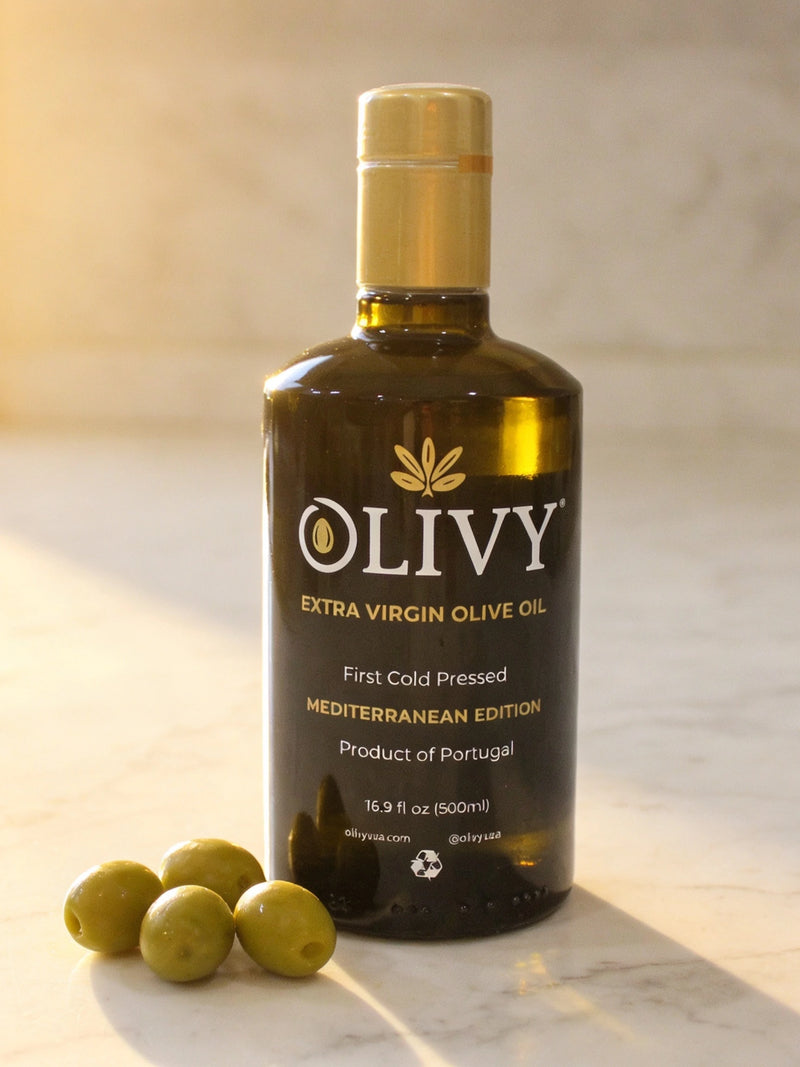
For the current harvest of the Mediterranean Edition, the panel reads 6.2 meq/kg peroxide value against the 20 meq/kg extra virgin limit, alongside 0.11% free acidity and 439 mg/kg total polyphenols. The published batches include February 2025, PDO Trás-os-Montes, batch #866.00/25.
Being straight about what that figure does and does not prove: 6.2 says the oil met little oxygen between the mill and the bottle — early pressing, dark glass, and a short route from grove to bottling. It does not prove the oil will still read 6.2 in your kitchen in a year. Nothing measured at bottling can. What it gives you is a documented starting point and a date, which is the most any producer can honestly offer, and considerably more than a number printed on a label with nothing behind it. The polyphenol side of the same report is covered in are high-polyphenol olive oils worth it.
Frequently asked questions
What is a good peroxide value for olive oil?
Lower is better, and the meaningful comparison is against the extra virgin ceiling of 20 meq O₂/kg set by the International Olive Council. A single-digit reading is consistent with a recent harvest that has been well protected from light, heat and air. A figure close to 20 still passes the grade but indicates the oil has already undergone substantially more oxidation.
What does meq O₂/kg mean?
It stands for milliequivalents of active oxygen per kilogram of oil. In practical terms it is a count of how many first-stage oxidation compounds are present, so a smaller number means less oxidation has taken place. You do not need the underlying chemistry to use it — read it against the 20 meq/kg limit for extra virgin.
Can a rancid olive oil still have a low peroxide value?
Yes, and this is the measurement's main limitation. The hydroperoxides that peroxide value counts are unstable and eventually break down into secondary oxidation products, the compounds responsible for a rancid smell. In a heavily deteriorated oil the peroxide reading can therefore plateau or fall while the oil continues to worsen, which is why it should be read alongside the K232 and K270 values.
Is peroxide value the same as acidity?
No. They measure different things at different stages. Free acidity records how the fruit was handled before and during pressing — bruising, delay, and fermentation all raise it. Peroxide value records oxidation that has happened since pressing, driven by light, heat, air and time. An oil can have excellent acidity and a mediocre peroxide value if it was well made but badly stored.
Does peroxide value tell you how many polyphenols an olive oil has?
No. Polyphenol content is measured separately and is not part of the extra virgin grade at all. The two are related only indirectly: polyphenols act as antioxidants inside the bottle, so a phenol-rich oil tends to resist oxidation for longer than a phenol-poor one stored the same way.
Written by The Olivy Kitchen. Every claim here ties to a published lab report or a cited source.
A peroxide value only means something when you can see the report it came from. Every Olivy harvest's full panel is public, batch numbers included, and the Mediterranean Edition ships with the batch number that matches it.
Sources
- International Olive Council — trade standard applying to olive oils and olive-pomace oils
- Peroxide Value — overview of primary oxidation measurement and its limits, ScienceDirect Topics
- Analysis of peroxide value in olive oils with an easy and green method, Food Control (2021)
- Olivy — published lab reports (6.2 meq/kg peroxide, 0.11% acidity, 439 mg/kg polyphenols, University of Lisbon)