Is Your Olive Oil Fake? How to Spot Real Extra Virgin Olive Oil

There is no reliable real extra virgin olive oil test you can run in your own kitchen. The fridge test, the lighter test, the "does it taste greasy" test — researchers at the UC Davis Olive Center put the most popular one under controlled conditions and found it doesn't distinguish real extra virgin from adulterated oil. Authenticity is settled by two things a home cook can't replicate: a chemistry panel and a trained sensory panel. What you can do at home is narrow the field fast — read the label for the four details that actually correlate with quality, taste for the two sensations that indicate fresh phenolic content, and then ask the producer for the lab report. This guide covers all three, and explains why the fraud headlines you've read are real but often mis-told.
How common is fake olive oil, really?

The number most people have heard is 69%. It comes from a real study, and it's worth understanding precisely, because the shorthand version has drifted a long way from what the researchers actually measured.
In 2010, the UC Davis Olive Center bought top-selling olive oils labeled "extra virgin" from California supermarkets and big-box stores and sent them for testing. Sixty-nine percent of the imported samples failed the International Olive Council sensory standard for extra virgin. Ten percent of the California-produced samples failed. The study was published, replicated in a follow-up, and it reshaped how the category talks about itself.
Here's the part that gets lost. Failing the sensory standard does not mean the bottle contained canola oil dyed green. In most cases it means the oil was defective — oxidized, fermented, musty, or simply old — and therefore no longer met the grade printed on the label. That is a genuine problem worth caring about. It's also a different problem from criminal adulteration, and the fix is different too.
One more piece of context that explains why this persists in the US. There is no mandatory federal standard for what "extra virgin" means on an American shelf. The USDA grade standards exist, and they closely mirror the IOC's, but participation is voluntary — a producer opts in. California enacted a mandatory state standard for its larger in-state producers, which is why California oils performed better in the UC Davis sampling. Everywhere else, "extra virgin" on a US label is a claim the producer is making, not a certification anyone verified.
That's the honest framing: most bottles aren't counterfeit. Many are simply older and more oxidized than the grade on the front implies, and almost nothing in the US system independently checks.
What "fake" actually means — three different problems
"Is my olive oil fake" is really three questions wearing one coat. Separating them tells you which one you can do something about.
| Problem | What happened | Can you detect it at home? |
|---|---|---|
| Adulteration | Cheaper oil (refined olive, seed oil) blended in and sold as extra virgin | No — requires chemistry |
| Grade failure | Genuine olive oil, but oxidized, fermented, or defective, so no longer extra virgin | Partly — a trained palate detects it; an untrained one often doesn't |
| Origin misstatement | Bottled in one country, olives grown in several others; "Product of X" describes packing, not growing | No — only traceability documentation shows this |
Origin misstatement deserves a note, because it surprises people. Under EU labeling rules a bottle may say "Product of Italy" when it was packed in Italy from olives grown across the Mediterranean. Nothing illegal is happening; the label is describing bottling. But if you bought it believing you were buying Italian olives, the label technically told the truth and practically misled you. This is exactly the gap that single-origin sourcing closes — we go through what that means in what single-origin actually means in extra virgin olive oil.
Does any real extra virgin olive oil test work at home?
The most widely shared real extra virgin olive oil test is the refrigerator test: chill the bottle, and if it solidifies it's pure. It spread widely after a 2013 television segment. It does not work, and we know that specifically because UC Davis tested it.
Researchers chilled seven samples in a laboratory refrigerator at 40.5°F. Their report found none of the samples congealed after 60 hours — including genuine extra virgin oils. Worse for the test's logic, a sample of real extra virgin cut with up to 50% lower-grade olive oil did solidify, meaning an adulterated bottle would have "passed."
The mechanism explains the result. Solidification depends on waxes and long-chain fatty acids, and those vary by cultivar, by region, and by harvest. They aren't a proxy for grade. Two honest extra virgin oils from different groves will behave differently in the cold.
The other kitchen tests fail for related reasons:
- The lighter / oil lamp test — whether an oil sustains a wick flame depends on water content and free acidity, not on whether it's extra virgin. Refined oils burn cleanly too.
- The color test — green versus gold reflects cultivar and ripeness at harvest, nothing more. Professional tasting panels use cobalt-blue glasses specifically to hide color, because it biases judgment without informing it.
- The "it doesn't taste bad" test — the most common defect in supermarket oil is a mild rancidity that reads as neutral or vaguely nutty to a palate that has never tasted fresh oil. Absence of an obvious off-note isn't evidence of quality.
None of this means you're helpless. It means the useful checks happen before you open the bottle, and after you learn what fresh actually tastes like.
The four label details that do predict quality

These four are worth more than any home experiment. Our full walkthrough lives in how to read an olive oil label and spot a fake; here is the short version.
1. A harvest date, not just a "best by"
A best-by date is calculated backward from a bottling date the producer chose. A harvest date tells you when the olives came off the tree, which is what actually governs freshness. Extra virgin olive oil is at its best within roughly 12–18 months of harvest, and research on phenolic stability shows meaningful decline past that window. A producer who knows their harvest date prints it. A producer who doesn't, can't.
2. A specific origin — a region, ideally a grove
"Product of the European Union" or a list of four countries tells you the oil was blended. A named region, and better still a named estate, means someone can be held to the claim. Protected designation schemes like DOP make this legally enforceable rather than aspirational.
3. Dark glass or tin
Light drives oxidation. Clear bottles accelerate the loss of exactly the compounds you're paying for. This is a packaging decision that costs the producer money and tells you they expect the oil to be judged on how it tastes months from now.
4. Published lab numbers — or a producer who'll send them
Free acidity, peroxide value, and polyphenol content are three numbers that describe an oil objectively. A bottle that publishes them is inviting a comparison it expects to survive. One that doesn't isn't necessarily hiding anything — most producers simply don't test every batch — but you have nothing to check.
What to taste for: bitterness, pepper, and defects
Your palate is the one instrument you already own, and it's more useful than any gadget once you know what to look for. Professionals score three positive attributes: fruitiness, bitterness, and pungency.
The pungency matters most for our purposes. That peppery catch at the back of the throat — the one that can make you cough on a fresh oil — comes largely from oleocanthal, a phenolic compound Gary Beauchamp's team identified in 2005 after noticing the sting resembled the sensation of swallowing liquid ibuprofen. Pungency is a rough sensory proxy for phenolic content. An oil with nothing at the back of the throat has little of the compound behind it.
Bitterness works similarly, and it's the attribute most often mistaken for a flaw. A slight bitterness on the sides of the tongue is a sign of a young, phenol-rich oil, not a defect. We walk through the professional method in how to evaluate EVOO like a professional.
The defects run the other way:
- Rancid — stale nuts, old crayons, putty. The most common defect by far, and the one an untrained palate reads as "normal."
- Fusty — a swampy, fermented smell from olives that sat in piles too long before pressing.
- Musty — damp cardboard or basement, from mold on the fruit.
- Winey — vinegar or nail polish, from fermentation.
Here's the practical exercise: buy one bottle you have genuine reason to trust, taste it neat against whatever is currently in your cupboard, and the contrast will teach you more in ninety seconds than any checklist. Most people who do this discover their existing bottle is rancid and they'd simply never had a reference point.
How authenticity is actually determined

Officially, an oil earns "extra virgin" by passing both a chemical panel and a sensory panel. The International Olive Council trade standard sets the thresholds:
| Parameter | What it measures | Extra virgin limit |
|---|---|---|
| Free acidity | Fatty-acid breakdown — damaged fruit, delayed pressing, rough handling | ≤ 0.8% |
| Peroxide value | Early-stage oxidation from heat, light, and air | ≤ 20 meq O₂/kg |
| K232 | UV absorbance — primary oxidation products | ≤ 2.50 |
| K270 | UV absorbance — secondary oxidation, also flags refined oil blended in | ≤ 0.22 |
| Sensory panel | Trained tasters scoring fruitiness and screening for defects | Zero defects; fruitiness > 0 |
Fail any one and the oil is not extra virgin, whatever the label says. Notice that K270 in particular does work no palate can do: it detects refined oil blended into virgin oil, because refining leaves a UV signature.
Polyphenol content isn't on that list, and that's a useful thing to understand. Total polyphenols aren't part of the grade — an oil can be legitimately extra virgin with modest phenolic content. Polyphenols are a separate axis, measuring how much of the antioxidant fraction survived from tree to bottle. The EU's reference point for a health-relevant level, set in Regulation 432/2012, is 5 mg of hydroxytyrosol and derivatives per 20 g of oil — commonly cited as roughly 250 mg/kg total.
How to verify a bottle before you buy it
Put together, this is the sequence that actually works:
- Check for a harvest date. No harvest date, no further consideration. This single filter removes most of the shelf.
- Check the origin. A single named region or estate, not a list of countries.
- Check the packaging. Dark glass or tin.
- Ask for the lab report. Email the producer and ask for the current harvest's acidity, peroxide value, and polyphenol result. The answer — and how quickly it comes — is itself informative.
- Taste it against a reference. Once it arrives, taste for fruitiness, bitterness, and that catch at the back of the throat.
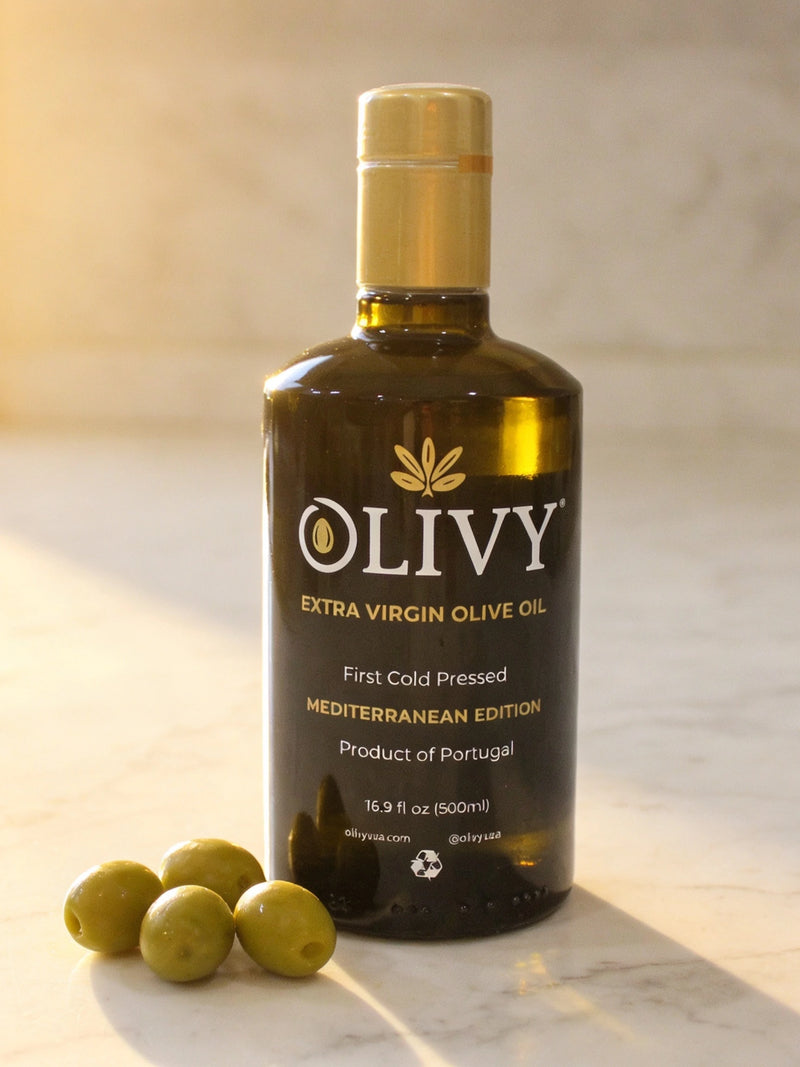
Step four is the one we built our own practice around, because it's the step where a claim either becomes verifiable or stays a claim. Every Olivy harvest goes to the Laboratório de Estudos Técnicos at the Instituto Superior de Agronomia, University of Lisbon — an independent university lab, not ours — and the full report is published, batch number and all, on our proof page. The current harvest of the Mediterranean Edition tested at 0.11% free acidity against the 0.8% legal ceiling, 6.2 meq/kg peroxide value against a 20 meq/kg limit, and 439 mg/kg total polyphenols.
We publish those because the alternative is asking you to take our word for it, and this is a category where people have been asked to do that a lot.
Frequently asked questions
Is there a real extra virgin olive oil test I can do at home?
Not a definitive one. Adulteration and grade failure are determined by chemical analysis and a trained sensory panel. The fridge test was specifically studied by UC Davis and found unreliable — genuine extra virgin oils failed to congeal, while oil cut with 50% lower-grade oil did. What works at home is checking the harvest date, origin, and packaging, then tasting for bitterness and peppery pungency against a reference bottle.
Does the fridge test tell you if olive oil is real?
No. UC Davis tested seven samples at 40.5°F for 60 hours and none congealed, including authentic extra virgin. Solidification depends on wax and long-chain fatty acid content, which varies by olive variety and region, so it isn't a proxy for grade or purity.
What does it mean if my olive oil doesn't taste peppery?
Peppery pungency comes largely from oleocanthal and related phenolic compounds, which decline with age, heat, and light exposure. A completely smooth oil is usually either from late-harvest fruit, an older bottle, or one that lost its phenolic content in storage. It isn't necessarily adulterated — but it's likely past its best.
Does "Product of Italy" mean the olives were grown in Italy?
Not necessarily. Under EU labeling rules that phrase can describe where the oil was bottled, with olives sourced from several countries. If growing origin matters to you, look for a single named region or a protected designation such as DOP, which ties the oil to a defined geographic area with an enforceable specification.
Is expensive olive oil always better?
No. Price reflects packaging, marketing, and distribution alongside quality, and a high price is not evidence of a good chemistry panel. The verifiable signals are the harvest date, a specific origin, dark packaging, and published lab results — a bottle carrying all four at a moderate price is a better bet than an expensive one carrying none.
Written by The Olivy Kitchen. Every claim here ties to a published lab report or a cited source.
If you want to see what a verified bottle looks like end to end, every Olivy harvest's full lab report is public, batch numbers included, and the Mediterranean Edition ships with the batch number that matches it.
Sources
- UC Davis Olive Center — Tests indicate that imported "extra virgin" olive oil often fails international and USDA standards (2010)
- UC Davis Olive Center — Refrigeration is not a reliable test for olive oil authenticity
- USDA AMS — Olive Oil and Olive-Pomace Oil Grades and Standards
- CDFA — California Grade and Labeling Standards for Olive Oil
- International Olive Council — Trade standard applying to olive oils
- Commission Regulation (EU) No 432/2012 — olive oil polyphenols claim
- Beauchamp et al., "Ibuprofen-like activity in extra-virgin olive oil," Nature 437:45–46 (2005)
- Olivy — published lab results (0.11% acidity, 439 mg/kg polyphenols, 6.2 meq/kg peroxide)