The Best High-Polyphenol Olive Oil Brands, Ranked by Lab Data

You can't honestly rank the best high-polyphenol olive oil brands by polyphenol count alone — but you can rank them by what they're willing to publish, and that turns out to be the more useful list. Published figures from brands that state one run from roughly 280 mg/kg to over 2,000 mg/kg. Those numbers were produced by different labs, in different harvest years, using different analytical methods, which means they aren't strictly comparable to each other. Below: what each brand actually publishes, why the numbers can't be lined up like a leaderboard, and the four questions that let you judge any polyphenol claim yourself.
How this ranking works
Most "best high-polyphenol olive oil brands" lists rank by a single number scraped off a product page. That produces a tidy leaderboard and a slightly dishonest one, because the numbers being compared were not generated under comparable conditions.
So this one ranks on documentation instead. For each brand we looked at three things, all from the brand's own published material:
- Is there a number at all? A stated mg/kg figure, not "rich in polyphenols."
- Is the number traceable? Does the brand name the harvest year, the testing lab, or the method — anything that lets the figure be located in reality?
- What else is published alongside it? Free acidity and peroxide value are the other two numbers that define an extra virgin oil's quality, and a brand that publishes all three is telling you considerably more than one that publishes a polyphenol count in isolation.
Nothing here is a quality verdict on anyone's oil. Several of these are excellent oils. The point is narrower: how much of each brand's claim you can actually check.
Why two polyphenol numbers usually aren't comparable

This is the part that most roundups skip, and it changes how you should read every figure below.
Method matters. Polyphenols in olive oil can be quantified several ways. HPLC following the International Olive Council's own procedure is the reference approach; NMR and LC-MS/MS are also used by accredited labs; and the older Folin-Ciocalteu colorimetric method measures total reducing capacity rather than the specific phenolic compounds the EU health claim cares about. These do not produce the same number for the same oil. A figure quoted without a method is a figure you can't place.
Harvest year matters. Polyphenol content is a property of a particular crop — cultivar, ripeness at picking, rainfall, altitude, how fast the fruit got to the mill. The same grove can swing substantially year to year. A number from the 2022 harvest tells you very little about the bottle you're buying in 2026.
Time matters. Polyphenols decline from the moment the oil is made. They're consumed as the oil oxidizes — which is part of why they're valuable, since they protect the oil itself. A count measured at bottling is a starting figure, not a permanent one. Our post on what mg/kg actually means goes deeper on how the measurement is produced and read.
None of this makes the numbers useless. It means a polyphenol figure is evidence, not a score — and evidence is only worth what its documentation is worth.
What actually counts as high-polyphenol
There's one threshold with legal force behind it. Under EU Regulation 432/2012, an olive oil may carry the approved claim that "olive oil polyphenols contribute to the protection of blood lipids from oxidative stress" only if it contains at least 5 mg of hydroxytyrosol and its derivatives per 20 g of oil. That works out to roughly 250 mg/kg, and it's where the phrase "high-phenolic" gets its practical floor. It's an EU labeling rule, not a US one, and it describes what the regulation permits a label to say — not a promise any brand can make on its own authority.
| Range | What it generally represents |
|---|---|
| Under 250 mg/kg | Below the EU claim threshold; typical of ordinary supermarket extra virgin, later harvests, or oil that has aged |
| 250–500 mg/kg | Genuinely high-polyphenol territory; usually early-harvest oil handled quickly and stored well |
| 500–1,000 mg/kg | Top tier; early-harvest, single-estate, often a high-phenolic cultivar and a very green pick |
| Above 1,000 mg/kg | Specialist "phenolic shot" territory; intensely bitter and pungent, closer to a supplement than a cooking oil |
Worth saying plainly: higher is not automatically better for a home kitchen. Very high-phenolic oils are aggressively bitter and peppery. They're wonderful on a bean soup and overwhelming on delicate fish.
The brands, by what they publish

| Brand | Published polyphenol figure | Traceability published | Acidity & peroxide published |
|---|---|---|---|
| Oleaphen | 2,236 mg/kg (2025–26 harvest) | Harvest year, LC-MS/MS method, IOC-accredited lab | Not stated in the release |
| Kosterina (Original) | 500+ mg/kg; Organic Everyday stated at 350+ mg/kg | "Independent third-party analysis at harvest"; results published per harvest | Not stated on the polyphenol FAQ |
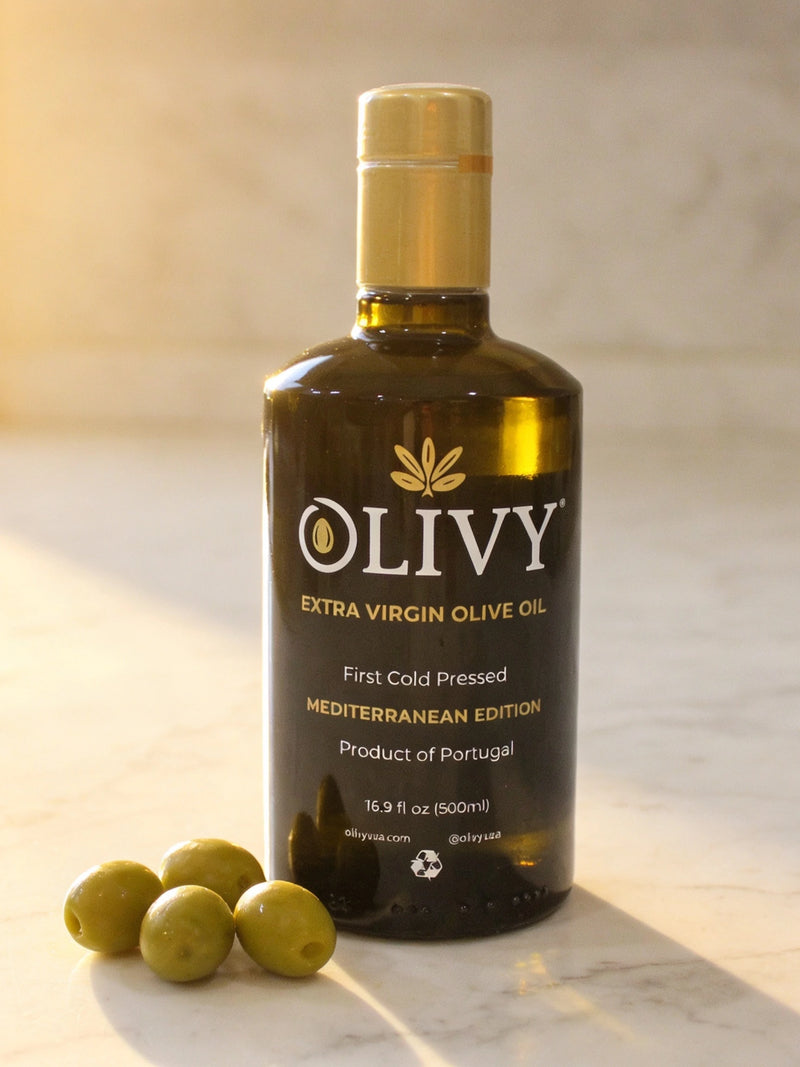
| Olivy (Mediterranean Edition) | 439 mg/kg | Named lab, named PDO region, batch numbers | Yes — 0.11% acidity, 6.2 meq/kg peroxide |
| Brightland (Alive) | 280–330 mg/kg | Harvest month and year, cultivars, region | Not stated |
| Graza (Drizzle) | No figure published — described as "extremely high in Polyphenols" | Cultivar, region, harvest timing | Not stated |
Oleaphen — the top of the published range
Oleaphen reports 2,236 mg/kg for its 2025–26 harvest, measured by LC-MS/MS at an IOC-accredited laboratory. That is an order of magnitude above ordinary extra virgin and firmly in specialist territory — an oil bought for its phenolic load, taken in small quantities, not the bottle you cook a family dinner with. The method and lab accreditation being named is exactly the kind of detail that makes a big number credible rather than decorative.
Kosterina — a stated figure and a per-harvest commitment
Kosterina states over 500 mg/kg for its Original EVOO and 350+ for the Organic Everyday, describing both as measured by independent third-party analysis at harvest, with results published for every harvest. The "+" formatting is a floor rather than a measurement, but publishing per harvest is the right instinct — it acknowledges that the number moves.
Olivy — 439 mg/kg, with the other two numbers attached
Our Mediterranean Edition tested at 439 mg/kg total polyphenols, 0.11% free acidity and 6.2 meq/kg peroxide value, analyzed by the Laboratório de Estudos Técnicos at the Instituto Superior de Agronomia, University of Lisbon. It's single-origin from PDO Trás-os-Montes in northern Portugal, early-harvest and first cold-pressed, and every batch is tested with the full report published against its lot number. We're not the highest number on this page and we don't pretend to be — 439 sits in the upper part of the genuinely-high band, which is where an oil you actually finish a dish with tends to live.
Brightland — a stated range, California-grown
Brightland publishes a polyphenol count of 280–330 mg/kg for Alive, along with an October 2025 harvest date, the Arbosana and Koroneiki cultivars, and California's Central Coast and Valley as the origin. A range rather than a single figure is a reasonable way to describe a crop, and the harvest date does real work. Acidity, peroxide and the testing lab aren't published alongside it.
Graza — strong sourcing detail, no polyphenol figure
Graza's Drizzle gives you the cultivar (Picual), the region (Jaén, Spain) and an early October harvest, and describes the oil as extremely high in polyphenols without quantifying it. Picual is genuinely a high-phenolic, oxidation-stable variety, so the description is plausible on its face. It's just not checkable, and Graza's proposition has always been freshness and everyday usability at a lower price point rather than a lab-report-led pitch — which is a legitimate thing for a brand to be.
What a polyphenol number doesn't tell you
- How old the oil in front of you is. A high count at bottling and eighteen months on a warm shelf can end up in the same place as a modest count kept properly. The harvest date is doing as much work as the mg/kg.
- Whether you'll like it. Polyphenols are the bitterness and the throat-catch. Above roughly 500 mg/kg that becomes the dominant flavor characteristic, which some people love and others quietly stop using.
- Whether the oil is fresh in every other sense. Peroxide value and free acidity are the freshness and fruit-quality markers, and neither is implied by a polyphenol count. Our piece on why third-party lab reports matter covers what a full panel includes.
- Whether the number came from this bottle's harvest. A figure that never changes across years is a marketing constant, not a measurement.
Four questions to ask about any polyphenol claim
[IMAGE IMG-3] — click this line in the editor, then Insert image → upload images/four-questions-polyphenol-claim.png; set alt to: "Card listing four questions to ask about any olive oil polyphenol claim"; then delete this line.
- Is there a number, or an adjective? "High in polyphenols" is a description. "439 mg/kg" is a claim someone can be held to.
- Which harvest is it from? If the brand can't tell you the crop year the figure belongs to, the figure isn't attached to anything.
- Who measured it, and how? A named laboratory and a named method — HPLC, NMR, LC-MS/MS — turn a number into a result.
- What else did they publish? Free acidity and peroxide value alongside the polyphenol count means someone ran a full panel and wasn't selective about which line they showed you.
A brand that answers all four isn't necessarily selling you the oil you'll enjoy most. It's selling you the one you can verify — and after the last few years of olive oil headlines, that's a reasonable thing to want. If you want the longer version of why verification became the thing to shop on, we wrote about the olive oil fraud problem separately.
Frequently asked questions
Which olive oil has the highest polyphenol content?
Among brands publishing a figure, Oleaphen reports the highest we found: 2,236 mg/kg for its 2025–26 harvest, measured by LC-MS/MS at an IOC-accredited lab. Figures at that level come from specialist high-phenolic producers and are far above ordinary extra virgin, which typically sits between about 100 and 500 mg/kg.
Is a higher polyphenol count always better?
Not for every use. Higher counts mean more antioxidant capacity and more oxidative stability, and also more bitterness and pungency. Above roughly 500 mg/kg the flavor becomes assertive enough that many people reserve it for robust dishes rather than everyday cooking.
Why do different brands' polyphenol numbers seem impossible to compare?
Because they usually are. Different analytical methods, different harvest years, and different testing labs all produce different figures for oils of similar quality. A number is only comparable to another number measured the same way, in the same season.
What polyphenol level does the EU health claim require?
EU Regulation 432/2012 permits the claim that olive oil polyphenols contribute to the protection of blood lipids from oxidative stress only for oils containing at least 5 mg of hydroxytyrosol and its derivatives per 20 g of oil — roughly 250 mg/kg. It's a European labeling rule and the claim must be accompanied by the statement that the effect is obtained with a daily intake of 20 g of olive oil.
Do polyphenols disappear as the oil sits in my kitchen?
They decline, yes. Polyphenols are consumed as the oil oxidizes, and light, heat and air all speed that up. Dark glass, a cool cupboard and finishing a bottle within a few months of opening all slow it down.
Written by The Olivy Kitchen. The Olivy Kitchen is Olivy's in-house editorial team, writing about single-origin extra virgin olive oil, how it's tested, and how to use it. Every claim is tied to a published lab report or a cited source.
This article is for general educational purposes and isn't medical or nutritional advice. Talk to your doctor or a registered dietitian about your individual needs.
All figures above come from each brand's own published material, as of August 2026. If you want to see what a full panel looks like: Olivy Mediterranean Edition publishes polyphenols, acidity and peroxide value for every batch, with the lab named and the lot number attached.