Is My Olive Oil Fake? The Olive Oil Fraud Problem, Explained

If you're asking "is my olive oil fake," the honest answer is that it's almost certainly real olive oil — and it may well not be extra virgin. Those are two different problems, and running them together is why this whole conversation gets so muddled. Outright adulteration does happen; European police seized 260,000 litres of counterfeit extra virgin in a single 2023 operation. But the far more common failure is quieter: oil that genuinely was extra virgin at the mill and stopped being extra virgin somewhere between the press and your pantry shelf. Here's how olive oil fraud actually works, what the research found, and what settles the question.
Is my olive oil fake, or just not extra virgin?
"Fake" is doing a lot of work in that question. To most people it means the bottle contains something other than olive oil — sunflower, canola, soybean, colored green and sold at a markup. That version exists, and we'll get to it. It is also the rarest of the three problems.
The much larger issue is grade. "Extra virgin" is not a marketing flourish; it's a quality grade with defined chemical and sensory limits. An oil earns it by being pressed from sound olives, quickly, without heat or solvents, and by testing under 0.8% free acidity with no perceptible taste defects. Oil that once met those limits can drift out of them. Heat, light, oxygen and time all degrade it. A bottle that sat under supermarket spotlights for fourteen months may still be olive oil in every chemical sense and no longer be extra virgin in any meaningful one.
So when someone tells you most olive oil is fake, they're usually describing a real finding in misleading words. The oil is real. The grade on the label often isn't holding up.
The three kinds of olive oil fraud
It helps to separate them, because they have different odds and different tells.
Grade fraud: sold as extra virgin, isn't
The most common by a wide margin. Sometimes it's deliberate — refined or lower-grade oil blended in and labeled up. Often it's negligence: an oil that was fine at bottling, handled badly through a long supply chain, and never retested. Either way the shopper pays an extra-virgin price for something that no longer tastes or tests like one. The giveaway is usually flavor. Rancid oil smells like old walnuts or crayons; fusty oil smells vaguely of compost or wine gone wrong. Both are defects that disqualify extra virgin, and both are common enough that many people have simply never tasted a fresh oil for comparison.
Origin fraud: the country on the front isn't where the olives grew
A bottle can say "Product of Italy" and legally mean the oil was bottled in Italy from olives grown somewhere else entirely. This is why the more useful label information sits in the small print: a named region, an estate, a harvest date, a lot code. A country name on the front of a bottle tells you far less than most people assume. Our guide to reading an olive oil label walks through which words on a bottle actually carry a legal definition and which don't.
Adulteration: another oil in the bottle
The rarest and the most criminal. In December 2023, Spanish and Italian investigators working under Europol's Operation OPSON seized about 260,000 litres of counterfeit extra virgin olive oil and arrested eleven people. The scheme wasn't seed oil in a green bottle — it was lampante, a low-grade olive oil with acidity above 2% that EU rules bar from sale for human consumption, blended with better oil and relabeled as extra virgin. In June 2025, four people were convicted in Spain for selling sunflower and low-grade oils as extra virgin and organic, one of dozens of incidents food-fraud analysts logged across 2023, 2024 and 2025.
Cases like these are real and they're worth knowing about. They are not, however, what's happening in most kitchens. Treating every disappointing bottle as a crime scene misses the ordinary, boring explanation that's usually correct: the oil is old.
What the UC Davis studies actually found
The number everyone quotes comes from the UC Davis Olive Center. In 2010, researchers bought imported olive oils labeled extra virgin from California supermarkets and put them through International Olive Council-accredited sensory panels. 69% of the imported samples failed the sensory standard for extra virgin. A follow-up report the next year tested 134 samples across eight brands and found that among the five top-selling imported brands, 73% of samples failed.
Read the researchers' own explanation of why, though, because it's the part that gets dropped. They attributed the failures to one or more of: oxidation from heat, light or age; adulteration with cheaper refined olive oil; and poor-quality oil made from damaged or overripe olives, or damaged by processing and storage. The defects the panels actually detected were rancidity and fustiness — the signatures of oxidation and fermentation, not of a different oil in the bottle.
Snopes eventually rated the viral "69% of olive oil is fake" version of this as a mixture, and the correction matters: the study did not find that those oils were made from something other than olives, and it didn't raise concerns about safety or substitution. It found that most of what was sold as extra virgin didn't taste like extra virgin.
That's still a serious finding. It's just a finding about freshness and grade discipline, which is a solvable problem, rather than a shadowy conspiracy, which isn't.
Why fraud rises when the harvest fails

Food fraud follows price. Drought across the Mediterranean cut olive harvests hard, and between 2022 and 2024 olive oil prices more than doubled, peaking in January 2024. Europol said the quiet part out loud when it announced the OPSON seizures: "general inflation of prices, reduced olive oil production, and increasing demand" had "created the perfect breeding ground for fraudulent producers."
Prices have eased since — by mid-2025 wholesale oil was trading at roughly 65% of that January 2024 peak — but the structural vulnerability didn't go anywhere. Olive oil is valuable, it comes in several grades that are genuinely hard to tell apart by eye, it carries organic and origin premiums worth faking, and it dilutes easily. Analysts still class it as one of the food categories most exposed to fraud.
Why a US label can't settle it
Here's the structural reason this persists in American supermarkets: there is no mandatory federal standard defining extra virgin olive oil in the United States. The USDA does publish grade standards — U.S. Extra Virgin Olive Oil requires free fatty acid content of not more than 0.8 grams per 100 grams, matching the international limit — but those grades are voluntary. A producer chooses whether to be graded. California has its own mandatory standard for oil produced in the state. Most bottles on a US shelf are imported and fall outside it.
Which means the words "extra virgin" on a bottle in Ohio are a claim, not a certification. Nobody is required to check them, and in the 2010 study, most of the time nobody had.
What a lab report proves — and what it doesn't
This is the part we care about most, because it's the only thing that converts a claim into a fact. Three numbers do most of the work:
| Number | What it measures | Extra-virgin limit |
|---|---|---|
| Free acidity | How much the fruit broke down before and during pressing — a proxy for how sound the olives were and how fast they were milled | 0.8% max |
| Peroxide value | Early-stage oxidation — how much air, heat and light the oil has taken on | 20 meq/kg max |
| Total polyphenols | The antioxidant compounds tied to flavor and to the oil's stability over time | No limit; the EU treats 250 mg/kg as the health-relevant reference point |

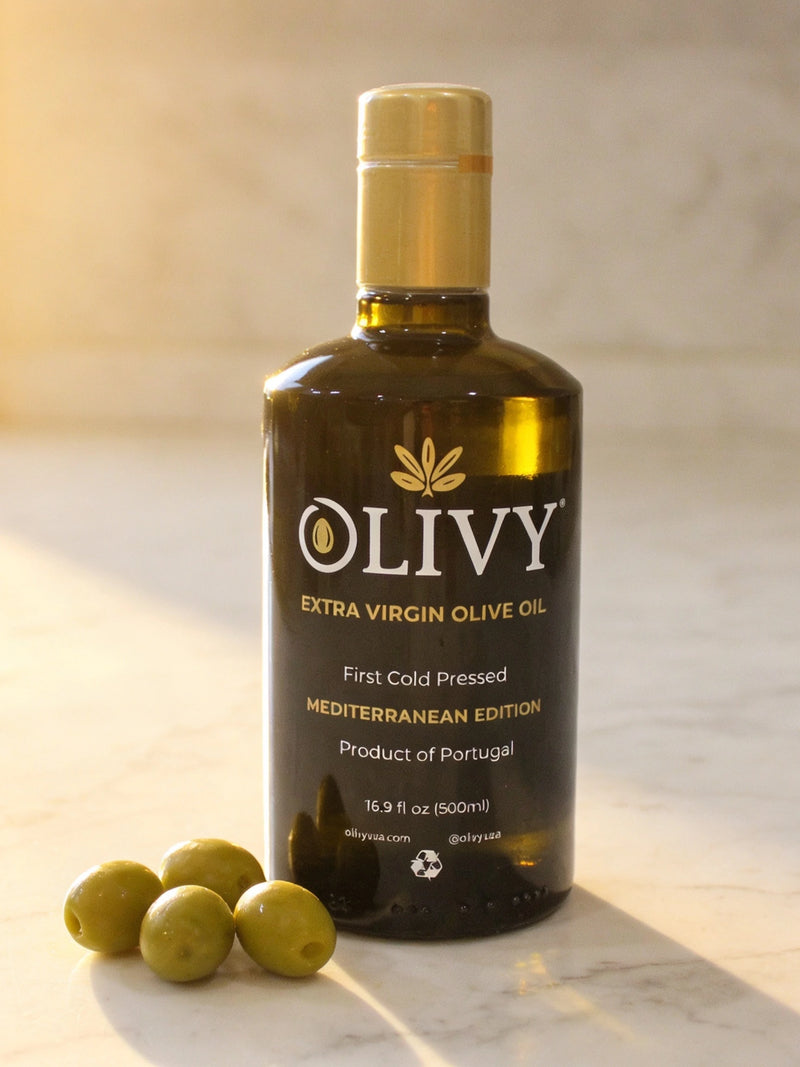
For context on what a current harvest can look like when it's tested: our Mediterranean Edition came back at 0.11% free acidity, 6.2 meq/kg peroxide value and 439 mg/kg total polyphenols, analyzed by the Laboratório de Estudos Técnicos at the Instituto Superior de Agronomia, University of Lisbon. Those reports are published on our proof page, batch by batch, because a number nobody can check is just a nicer-sounding claim. If you want the longer version of what each figure means, we've written separately about what acidity actually tells you and what a peroxide value is measuring.
What a report can't do is travel with the bottle forever. It's a snapshot of a batch at a moment. Polyphenols decline, peroxide creeps up, and an oil tested at bottling will not test identically two years later in a warm cupboard. That's the honest limit of the tool, and it's why a harvest date matters as much as a lab result.
What to check before you buy
- A harvest date, not just a best-by. Best-by dates are set by the bottler and tell you almost nothing. A harvest date tells you the oil's actual age. Under a year old is the zone worth paying for.
- Dark glass or tin. Light drives the oxidation that caused most of the UC Davis failures. A clear bottle on a bright shelf is a countdown.
- A named place, not a country. A region, an estate, a lot code — something specific enough to trace.
- A lab report you can actually read. Not "lab tested" as a phrase, but the report itself, with numbers and a lab's name on it. Our post on what third-party testing should look like covers what to ask for.
- Taste it properly. Fresh extra virgin is bitter and peppery, sometimes enough to make you cough. Flat, greasy, or nutty-in-a-stale-way means the oil is past it, whatever the label says. There's a full walkthrough in our piece on testing whether an olive oil is really extra virgin.
None of this requires becoming an expert. It mostly requires refusing to accept a claim that comes with no way to check it — which, given what the research found, is a reasonable position for a shopper to take.
Frequently asked questions
Is 69% of olive oil fake?
No. The 69% figure comes from a 2010 UC Davis study in which imported oils labeled extra virgin failed an accredited sensory panel — meaning they had taste defects like rancidity and didn't meet the extra virgin standard. The study did not find those oils were made from something other than olives, and it didn't raise safety or substitution concerns.
Can you tell if olive oil is fake by putting it in the fridge?
No. The fridge test is folklore. Real extra virgin olive oil may or may not cloud or solidify when chilled depending on its fatty acid profile and how cold it gets, and so may oils cut with other fats. It tells you nothing reliable. Taste and a lab report are what work.
Does a higher price mean the oil is genuine?
Not on its own. Price tracks packaging, marketing and distribution as much as it tracks quality, and the fraud cases on record involved oil sold at premium prices. What price can buy is a shorter, more traceable supply chain and the cost of independent testing — but only if the producer publishes the results.
Is supermarket olive oil safe to eat?
The UC Davis research was about quality grade, not safety — the oils that failed were still olive oil. The practical risk in a mislabeled bottle is that you paid extra-virgin money for oil that has lost the flavor and the polyphenols you were paying for.
How do I know a brand's lab report is real?
Look for the testing laboratory named on the report, a batch or lot number that matches the bottle in your hand, and a date. A report with no lab name, no lot reference, or no date is a graphic, not a document.
Written by The Olivy Kitchen. The Olivy Kitchen is Olivy's in-house editorial team, writing about single-origin extra virgin olive oil, how it's tested, and how to use it. Every claim is tied to a published lab report or a cited source.
If you want to see what a checkable claim looks like: Olivy Mediterranean Edition is single-origin from PDO Trás-os-Montes in northern Portugal, and every harvest's full lab report is public — acidity, peroxide, polyphenols, batch number and all.