What Does mg/kg Polyphenols Mean on an Olive Oil Label?

On an olive oil label or lab report, mg/kg means milligrams of polyphenols per kilogram of oil — the same thing as parts per million. An oil listed at 439 mg/kg contains 439 milligrams of polyphenols in every kilogram, which works out to roughly 6 mg in a tablespoon. The unit itself is simple. What makes the number hard to use is everything around it: which compounds were counted, which laboratory method produced the figure, when the oil was measured, and what "high" actually means. Here is how to read all of that.
What does mg/kg mean as a unit?
mg/kg is milligrams per kilogram — one part in a million. It is identical to ppm, and the two are used interchangeably on olive oil reports. Some producers write "ppm" and some write "mg/kg"; a 439 ppm oil and a 439 mg/kg oil are the same oil.

Translated into kitchen quantities, it becomes easier to hold onto. Olive oil weighs about 0.92 kg per litre, so:
- A 500 ml bottle holds roughly 458 g of oil. At 439 mg/kg, that is about 200 mg of polyphenols in the bottle.
- A tablespoon is about 13.5 g. At 439 mg/kg, that is roughly 6 mg.
Those are small absolute numbers, which is normal — polyphenols are minor components of olive oil by weight, and they are potent at low concentrations. The figure is useful for comparing oils to each other, not for estimating a dose.
Where the 250 mg/kg reference point comes from
The 250 mg/kg figure that appears throughout this category traces back to a single European Union regulation — not to a US standard, and not to a marketing convention. Knowing its origin explains both why it is used and why it should be read carefully.
EU Regulation 432/2012 sets a labelling threshold of 5 mg of hydroxytyrosol and its derivatives per 20 g of oil. Divide it out — 5 mg in 20 g is 0.25 mg per gram — and you get 250 mg per kilogram. That is the whole derivation. Every "250 mg/kg" you see quoted in this category is that arithmetic.
Two caveats belong with it, and most write-ups skip both:
- It is defined on a subset, not on total polyphenols. The regulation counts hydroxytyrosol and its derivatives specifically. A "total polyphenols" figure is a broader measurement that includes compounds outside that group. So 250 mg/kg total is a widely-used approximation of the threshold, not an exact equivalent of it.
- It is an EU labelling rule, and it has no force on a US label. It is cited here for one reason only: it is where the number came from. Treat it as a measurement reference line, not as a regulatory standard that applies to what you are buying.
Read that way, 250 mg/kg is a useful comparison point rather than a magic threshold. It marks the level at which one regulator drew a line for labelling purposes.
A note on scope: this article is about how to read the number, not about what polyphenols do. That is a separate topic with its own evidence and its own caveats, and it is covered in the polyphenol guide.
What counts as a high polyphenol figure?
Most supermarket extra virgin olive oil falls somewhere between about 50 and 250 mg/kg. Above roughly 300 mg/kg is commonly described as high-phenolic in the research literature, and figures above 800 mg/kg are genuinely uncommon.
| Total polyphenols | How it reads |
|---|---|
| Under 100 mg/kg | Low — often refined, blended, late-harvest, or simply old |
| 100 – 250 mg/kg | Ordinary range for mass-market extra virgin |
| 250 – 300 mg/kg | At or above the EU reference line |
| 300 – 500 mg/kg | High-phenolic by the common literature definition |
| Above 500 mg/kg | Unusual — typically very early harvest, specific cultivars, immediate milling |
Treat those bands as orientation rather than grades. There is no legal definition of "high polyphenol," which is why the specific figure matters more than the phrase — the same problem the word "low acidity" has, taken apart in what actually qualifies as low acidity.
Worth noting too: a higher number is not automatically a better oil for every use. Polyphenols carry the bitterness and the peppery catch at the back of the throat, and a very high-phenolic oil can overwhelm delicate food. Whether the extra is worth it is weighed up in are high-polyphenol olive oils worth it.
Why two labs can report different polyphenol numbers
Because "polyphenols" is a family of compounds, not one substance, and different analytical methods count different members of it. Two honest laboratories can analyse the same oil and publish figures that do not match.

HPLC — the IOC's official method
The International Olive Council recognises one accredited method for biophenol analysis: COI/T.20/Doc. No 29, high-performance liquid chromatography with diode-array detection. It separates the individual compounds and quantifies them, so it reports what is actually present, compound by compound.
Folin-Ciocalteu — the colorimetric estimate
The Folin-Ciocalteu assay is a colour-change test. A reagent reacts with phenolic compounds to produce a blue tint whose intensity is measured and compared against a reference standard, usually gallic acid. It is faster and cheaper, and it estimates total phenolic content rather than identifying specific compounds — which also means it can respond to non-phenolic substances that reduce the reagent.
The practical consequence: a Folin figure and an HPLC figure are not directly comparable, and Folin results are often the higher of the two. So when you compare two brands' polyphenol claims, you are only making a fair comparison if both used the same method. A report that names its method is doing you a favour; one that does not is asking you to assume.
Why the number on the label may not be the number in your bottle
Polyphenols degrade over time. A figure measured at pressing describes the oil at that moment, and the oil in your kitchen is older than that.
Three things drive the decline, and all three are ordinary: exposure to oxygen, exposure to light, and warmth. This is why dark glass and a cool cupboard are not fussiness — they are the difference between a number that roughly holds and one that quietly falls. The mechanics of that are in how to store olive oil so it doesn't go rancid.
It also means two dates matter as much as the figure itself: when the oil was harvested, and when it was tested. A 500 mg/kg result from a harvest three years ago tells you very little about the bottle on the shelf today. A 439 mg/kg result from the current pressing, with the batch number attached, tells you a great deal more.
Reading mg/kg on a real report
Ours is a useful worked example because the whole document is public rather than a single quoted line.
| Parameter | Result | What it answers |
|---|---|---|
| Total polyphenols | 439 mg/kg | Antioxidant content — EU reference point is 250 mg/kg |
| Free acidity | 0.11% | How gently the fruit was handled before milling |
| Peroxide value | 6.2 meq/kg | How well the oil has been protected since pressing |
439 mg/kg sits in the high-phenolic band and comfortably above the EU reference line. It comes from early-harvest, first cold-pressed fruit from a single PDO Trás-os-Montes grove in northern Portugal, analysed by the Laboratório de Estudos Técnicos at the Instituto Superior de Agronomia, University of Lisbon. Early harvesting is the main reason it is where it is: green, under-ripe olives carry more phenolic compounds and yield less oil, which is a real trade the producer has to choose to make.
The peroxide figure sitting beside it matters for the polyphenol number too. Both respond to oxidation, so a low peroxide value is indirect evidence that the phenolic content has been protected since pressing. Reading them together is the point of publishing the whole panel — the reasoning behind that is in what to look for in third-party testing.
Frequently asked questions
What does mg/kg mean on an olive oil label?
It means milligrams of the measured substance per kilogram of oil, which is the same as parts per million. For polyphenols, an oil at 439 mg/kg contains 439 milligrams of polyphenols in each kilogram of oil — roughly 6 mg per tablespoon, or about 200 mg in a 500 ml bottle.
Is 250 mg/kg of polyphenols good?
It is the reference point used across the category, derived from EU Regulation 432/2012, which sets a threshold of 5 mg of hydroxytyrosol and its derivatives per 20 g of oil. Most mass-market extra virgin olive oil falls below it. Above roughly 300 mg/kg is commonly described as high-phenolic in research literature, and the EU threshold is defined on a specific subset of compounds rather than on total polyphenols, so treat the comparison as approximate.
What is a high polyphenol count for olive oil?
There is no legal definition. In practice, figures above about 300 mg/kg are described as high-phenolic, 500 mg/kg and above is unusual, and anything over 800 mg/kg is rare. The number depends heavily on harvest timing, olive variety, and how quickly the fruit was milled, and it declines with age and exposure to light, heat and air.
Why do different brands report polyphenol numbers that don't match?
Mostly because of testing method. The International Olive Council's accredited method is HPLC with diode-array detection (COI/T.20/Doc. No 29), which separates and quantifies individual compounds. The Folin-Ciocalteu assay is a colorimetric estimate of total phenolic content and typically returns higher figures. The two are not directly comparable, so a fair comparison requires both brands to name the same method.
Does polyphenol content decrease over time?
Yes. Polyphenols degrade through exposure to oxygen, light and warmth, so a figure measured at pressing describes the oil at that moment rather than the bottle in your kitchen months later. Dark glass, a cool cupboard and a recent harvest date all help the measured number stay closer to the number you actually get.
Written by Pedro Borges, Co-Founder of Olivy. Raised in a family where good food was a daily ritual, Pedro brings firsthand knowledge of single-origin olive oil straight from the source. His writing reflects years of working closely with Portuguese producers and a genuine passion for the craft behind every bottle. Every claim here ties to a published lab report or a cited source.
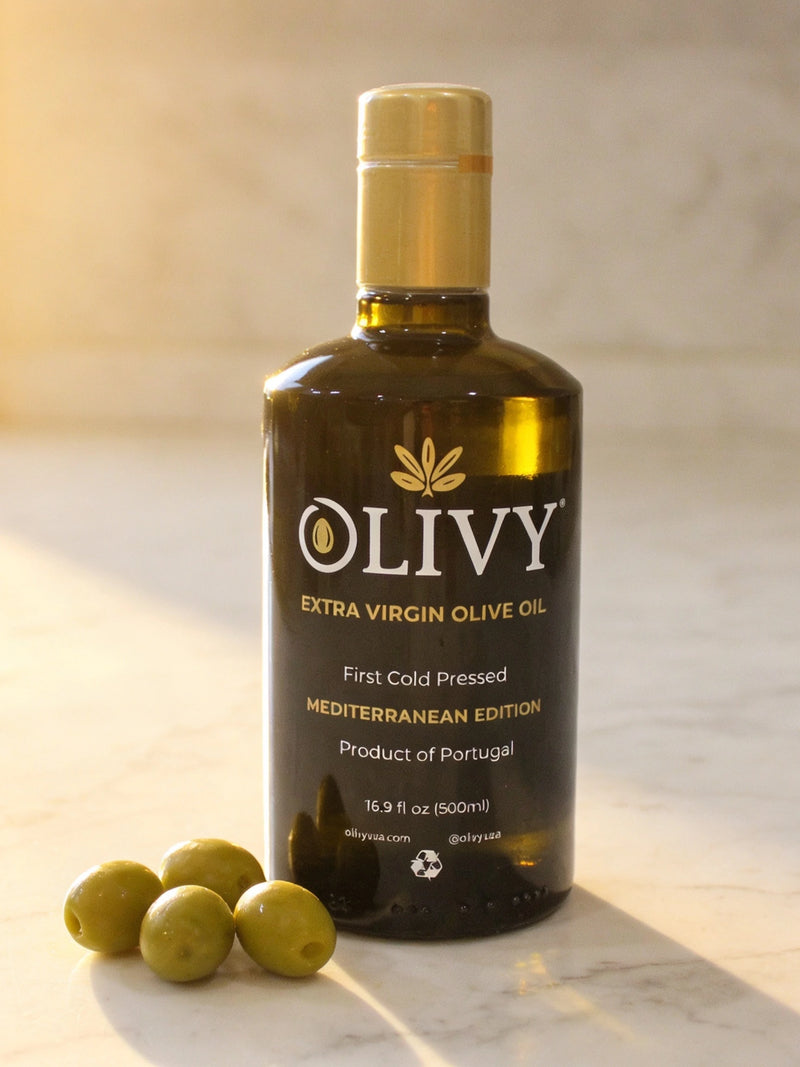
A polyphenol figure is only as good as the report it came from. Every Olivy harvest's full lab panel is public, batch codes included, and the Mediterranean Edition ships with the batch number that matches the report.
Sources
- EU Commission Regulation (EU) No 432/2012 — list of permitted health claims (olive oil polyphenols; 5 mg hydroxytyrosol and derivatives per 20 g)
- International Olive Council — standards and methods, including COI/T.20/Doc. No 29 (biophenols by HPLC)
- International Olive Council — Trade standard (Rev. 20)
- Olivy — published lab reports (439 mg/kg total polyphenols, University of Lisbon)