What Is DOP-Certified Olive Oil, and Why It Matters

DOP olive oil is oil certified under the EU's Protected Designation of Origin scheme — meaning the olives were grown, and the oil produced, inside a defined geographic area, following a published specification that an independent body verifies. DOP is the Portuguese and Italian abbreviation; PDO is the English one, and DO the Spanish. They're the same legal instrument. What makes it useful to a shopper is unusually concrete for a food label: unlike "extra virgin" in the United States, which no one is required to check, a DOP claim is tied to a written specification and an audit. Here's what the certification actually guarantees, what it doesn't, and how to read one.
What is DOP olive oil?

Denominação de Origem Protegida — Protected Designation of Origin — is one of three EU quality schemes governed by Regulation (EU) No 1151/2012. It's the strictest of them. For a product to carry DOP:
- Every production step — growing, harvesting, and processing — must happen within the defined geographic area.
- The product's characteristics must be essentially or exclusively due to that place: its soil, climate, altitude, traditional varieties, and local know-how.
- Production must follow a published specification, and compliance is verified by an independent control body, not by the producer.
That middle condition is the philosophical core of the scheme, and it's stricter than it first sounds. The claim isn't just "made here." It's that the product could not be the same if it were made somewhere else — which is why DOP specifications tend to name permitted olive varieties, define harvest and extraction methods, and set chemical and sensory limits tighter than the general extra virgin standard.
You'll see the same instrument written three ways depending on the language: DOP in Portuguese and Italian, PDO in English, DO in Spanish. Same scheme, same legal force across the EU.
How a DOP is earned — and enforced
A DOP isn't applied for by a single producer. It's registered by a group — a consortium or producers' association — on behalf of a region, and the process is slow by design.
- The group drafts a specification. Geographic boundaries, permitted varieties, agronomic practices, harvest window, extraction method, and the chemical and sensory parameters the finished oil must meet.
- The national authority reviews it, then forwards it to the European Commission.
- The Commission publishes it for objection, allowing other member states or interested parties to challenge the claim.
- If unopposed, it's registered in the EU register, and the name becomes legally protected across the Union.
Enforcement is what makes it more than a badge. Once registered, the name is protected against misuse, imitation, and evocation — even where the true origin is stated, and even with phrases like "style" or "type." An oil produced outside the area cannot call itself by a registered DOP name.
Individual producers within the area are then audited by the designated control body against that specification. Failing an audit means losing the right to use the name on that batch — a real, batch-level consequence, which is what distinguishes DOP from a self-declared origin claim.
DOP vs PGI vs organic: what each one covers
These get conflated constantly, and they answer genuinely different questions.
| Scheme | What it certifies | Geographic requirement |
|---|---|---|
| DOP / PDO | Origin and character — the product's qualities are due to the place | All production stages in the defined area |
| IGP / PGI | A link to a place, but a looser one | At least one stage in the area; raw materials may come from elsewhere |
| Organic | Farming inputs and methods — no synthetic pesticides or fertilisers | None. Says nothing about origin |
Two things fall out of that table.
Organic and DOP are orthogonal. An oil can be one, both, or neither, and neither implies the other. Organic certification governs how the trees were farmed; DOP governs where and how the oil was made and what it must taste and test like.
None of them is a quality grade in the sense that "extra virgin" is. DOP specifications usually require extra virgin status and often set tighter limits — but the schemes answer "where and how" rather than "how good." An oil can be DOP-certified and past its best if it's been sitting in a warm shop for two years.
What DOP guarantees — and what it doesn't
Being precise about this is more useful than enthusiasm.
What it does guarantee:
- Real geographic origin, verified by an independent body. This is the big one — it closes the "Product of Italy means bottled in Italy" gap, where a label can be technically accurate and practically misleading.
- Adherence to a published specification covering varieties, methods, and quality parameters — a document you can read.
- Traceability through the certification chain, back to a defined area and usually a defined mill.
- Legal protection of the name, enforceable across the EU.
What it doesn't guarantee:
- Freshness in your bottle. Certification happens at production. Nothing about a DOP seal tells you the harvest date or how the oil was stored since.
- A specific polyphenol level. Most specifications don't set a phenolic minimum, and phenolic content isn't part of the extra virgin grade either. Two DOP oils from the same region can differ substantially — see are high-polyphenol olive oils worth it.
- Batch-level lab transparency. The control body sees the audit results. You generally don't. Published per-batch reports are a separate practice on top of certification, not part of it — which is the distinction we draw in why third-party lab reports matter.
- A single grove. A DOP area can span thousands of hectares and many producers. DOP and single-origin are related but not identical claims — we untangle them in what single-origin actually means.
The honest summary: DOP is strong evidence about where and how, and silent about when and how much. It pairs well with a harvest date and a lab report, and doesn't replace either.
A worked example: Azeite de Trás-os-Montes DOP

Portugal has six registered olive oil DOPs, most created in the mid-1990s. Trás-os-Montes, in the country's mountainous north-east, is one of them — a high, dry, continental region of terraced groves, cold winters and hot summers, the kind of water-stressed growing conditions that push olive trees to produce more defensive compounds.
The registered specification for Azeite de Trás-os-Montes defines the oil as a low-acidity extra virgin olive oil from a named set of regional varieties — Verdeal Transmontana, Madural, Cobrançosa and Cordovil among them — extracted by mechanical means within the designated area. It describes the expected sensory profile too: fresh fruit aroma, an occasional almond note, and a balanced sweet-bitter-pungent finish that distinguishes it from Portugal's other DOP oils.
That's the level of specificity these documents run to, and it's why they're worth reading. A specification tells you what the region committed to, in writing, before anyone was selling you anything.
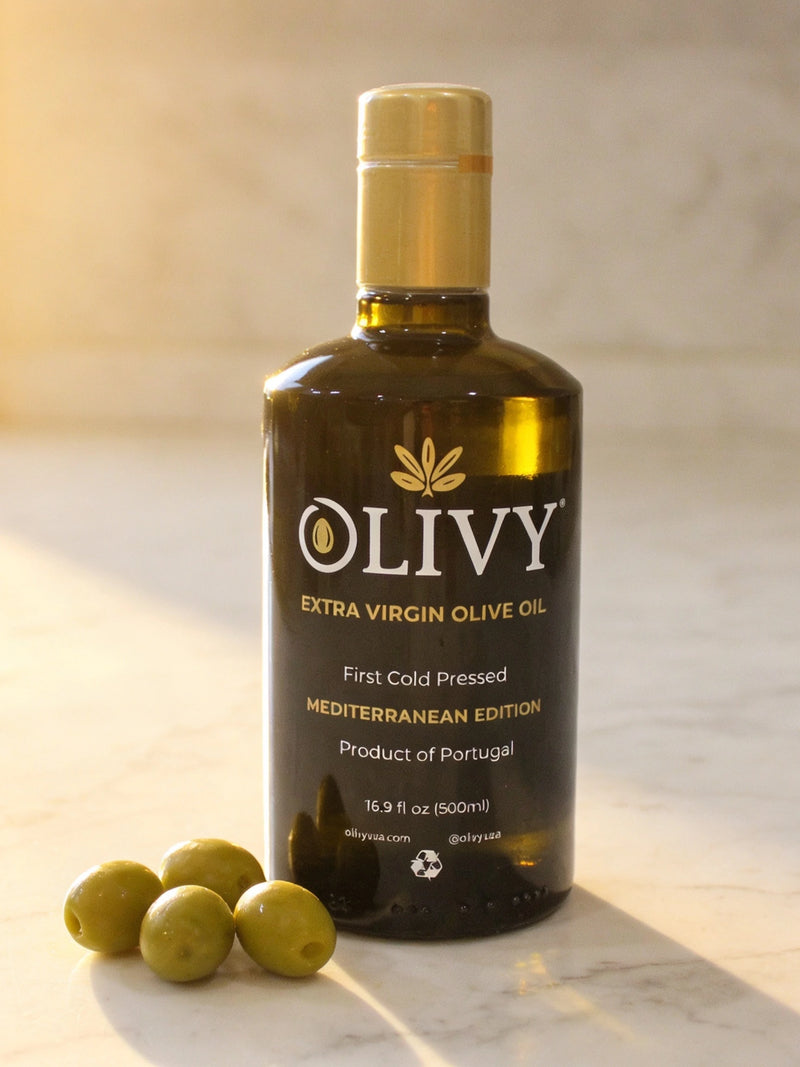
Our own Mediterranean Edition is a single-origin oil from the PDO Trás-os-Montes area — the February 2025 batch on our proof page is labelled as such, batch #866.00/25. We don't publish our varietal breakdown, so we won't tell you which of the region's varieties are in the blend; what we do publish is the full independent analysis for every harvest, which for the current one reads 0.11% free acidity, 6.2 meq/kg peroxide value, and 439 mg/kg total polyphenols. The designation says where it's from. The report says what's in it. We think you want both, and there's more on the region itself in why Portuguese olive oil is the Mediterranean's best-kept secret.
How to read a DOP claim on a label
Four checks, in order:
- Look for the EU symbol. PDO uses a circular red-and-yellow emblem. Its presence means a registered designation; its absence alongside the letters "DOP" is worth a second look.
- Check that a specific designation is named. "DOP Trás-os-Montes" is a registered name. "DOP quality" or "DOP style" is not a claim about anything — and evocative phrasing of that kind is precisely what the regulation prohibits.
- Look up the register. The European Commission maintains a public database of registered geographical indications. Any legitimate DOP is listed, with its full specification.
- Then check everything DOP doesn't cover. Harvest date, dark packaging, and whether a lab report exists for the batch. Certification and freshness are separate questions, and only one of them is answered on the front of the bottle.
Why it matters more in olive oil than in most categories
Origin certification is useful in any food. It's disproportionately useful here because of a specific gap in how olive oil is regulated.
In the United States there is no mandatory federal standard for what "extra virgin" means. The USDA grade standards exist and mirror international ones, but participation is voluntary. California imposes a mandatory standard on its larger in-state producers; elsewhere, "extra virgin" on a US shelf is a producer's own assertion. When the UC Davis Olive Center tested imported oils sold in California in 2010, 69% of the imported samples failed to meet the international sensory standard for the grade on their label.
Against that background, a DOP claim is one of the few label elements with an audit behind it. It doesn't solve freshness, and it doesn't tell you the phenolic content. But it converts one of the vaguest claims in the category — where this came from — into something written down and checked by someone other than the seller. That's a meaningful amount of the work, and the rest of it is covered in how to spot real extra virgin olive oil.
Frequently asked questions
What does DOP mean on olive oil?
DOP stands for Denominação de Origem Protegida — Protected Designation of Origin — an EU certification under Regulation 1151/2012. It means every stage of production, from growing the olives to extracting the oil, happened inside a defined geographic area, following a published specification verified by an independent control body. PDO is the English abbreviation for the same scheme.
Is DOP olive oil better than regular extra virgin?
DOP certifies origin and adherence to a regional specification rather than quality on its own, though most specifications require extra virgin status and often set tighter chemical and sensory limits. It doesn't guarantee freshness or polyphenol content, so a DOP oil with an old harvest date can be a worse bottle than a recent, well-stored non-DOP oil.
What's the difference between DOP and IGP?
DOP requires all production stages — growing, harvesting, and processing — to take place in the defined area, and the product's qualities must be essentially due to that place. IGP, or PGI in English, requires only that at least one stage happens there, and raw materials may come from elsewhere. DOP is the stricter of the two.
Does DOP olive oil have more polyphenols?
Not necessarily. Most DOP specifications don't set a minimum polyphenol level, and phenolic content isn't part of the extra virgin grade either. It's driven mainly by harvest timing, variety, how quickly the fruit was pressed, and storage. The only way to know a specific oil's level is a lab report for that batch.
How do I check whether a DOP claim is real?
Look for the EU's circular PDO emblem and a specific registered name such as "Azeite de Trás-os-Montes" rather than a vague phrase like "DOP quality." Then check the European Commission's public register of geographical indications, where every registered designation is listed with its full specification.
Written by The Olivy Kitchen. Every claim here ties to a published lab report or a cited source.
A designation tells you where an oil is from; a lab report tells you what's in it. Every Olivy harvest's report is public, batch numbers included, and the Mediterranean Edition is single-origin from the PDO Trás-os-Montes area.
Sources
- Regulation (EU) No 1151/2012 — quality schemes for agricultural products and foodstuffs
- European Commission — eAmbrosia, the EU geographical indications register
- Albuquerque et al., "An Overview of Portuguese Olive Oils and Table Olives with Protected Designation of Origin," European Journal of Lipid Science and Technology (2019)
- USDA AMS — Olive Oil and Olive-Pomace Oil Grades and Standards (voluntary)
- UC Davis Olive Center — Evaluation of extra virgin olive oil sold in California (2010)
- Olivy — published lab reports, including batch #866.00/25, PDO Trás-os-Montes