Hydroxytyrosol in Olive Oil: What It Is and How It's Measured

A note on what this article is. It's a piece about a molecule — where hydroxytyrosol comes from, how much of it sits in different foods, and how laboratories put a number on it. It isn't about health effects, and it doesn't make any claim about what the compound does in the body.
Hydroxytyrosol in olive oil is a small phenolic compound that mostly isn't in the olive to begin with — it's created when oleuropein, the compound that makes a raw olive too bitter to eat, breaks down during ripening and milling. It matters commercially for one specific reason: it's the compound European labeling rules are written around, which makes it the closest thing this category has to an agreed unit of measurement. Below: where it comes from, how much is in what, why the number on a label counts more than hydroxytyrosol alone, and how the figure is actually produced.
What is hydroxytyrosol in olive oil?
Hydroxytyrosol is a phenolic alcohol — a small molecule found throughout the olive tree, in the fruit, the leaves, the oil, and the wastewater left over from milling. Chemically it belongs to the same family as tyrosol, and it sits at the centre of the group of compounds usually referred to collectively as "olive oil polyphenols."
Among those compounds it's the one that gets singled out. It was identified early as having the strongest in-vitro antioxidant potential of the olive oil phenolics — meaning that in laboratory conditions it readily donates an electron to neutralize a reactive molecule. That's a measured chemical property of the substance in a test tube, and it's the reason analytical chemists and regulators built their reference points around this particular molecule rather than one of its neighbours.
Where it comes from

Here's the part that surprises people: hydroxytyrosol largely isn't sitting in the olive waiting to be collected.
A green olive is full of oleuropein — the intensely bitter glycoside that makes raw olives inedible and that has to be cured out of table olives before anyone can eat them. As the fruit ripens, enzymes progressively break oleuropein down, and hydroxytyrosol is one of the products. The same breakdown continues during milling, when the fruit's cell walls are ruptured and its enzymes meet substrates they were previously separated from.
Which means hydroxytyrosol content works as an indicator of how far the fruit has matured. It also means the compound's concentration in a finished oil is downstream of a whole chain of decisions — when the fruit was picked, how quickly it reached the mill, how it was processed — rather than being a fixed property of the variety.
How much is in what
Concentrations vary by orders of magnitude depending on the source:
| Source | Reported hydroxytyrosol content |
|---|---|
| Black table olives | ~5.78 g/kg |
| Green table olives | ~4.48 g/kg |
| Extra virgin olive oil | Reported from around 14 mg/kg upward as free hydroxytyrosol |
| Refined olive oil | Less than 2 mg/kg |
Two things are worth pulling out of that table.
Table olives carry vastly more than oil does — grams per kilo against milligrams per kilo. The fruit keeps most of it; only a fraction carries through into the pressed oil.
Refining strips it almost entirely. Under 2 mg/kg is effectively nothing. Refining uses heat, and often solvents and deodorization, and phenolic compounds don't survive that treatment. This is the single cleanest illustration of why "extra virgin olive oil" and "olive oil" are not interchangeable terms on a label — they're chemically different products, and this compound is one of the places the difference shows up as a number.
Why labels count "and its derivatives"
If you compare that 14 mg/kg figure against the polyphenol counts brands print — 300, 439, 800 mg/kg — the arithmetic looks broken. It isn't. The two are counting different things.
In extra virgin olive oil, most hydroxytyrosol is not free. It exists in bound form, built into larger secoiridoid molecules — the oleuropein complex, along with tyrosol and its own derivatives. Those larger molecules break down and release hydroxytyrosol later, during digestion and metabolism. So a measurement of free hydroxytyrosol alone systematically undercounts what the oil is actually carrying.
Which is why EU Regulation 432/2012 doesn't set a threshold for free hydroxytyrosol. It sets a compositional cut-off for "hydroxytyrosol and its derivatives (e.g. oleuropein complex and tyrosol)" — at least 5 mg per 20 g of olive oil. That works out to roughly 250 mg/kg, and it's where the industry's "high-phenolic" line comes from. It's a European labeling rule rather than a US one, and what it governs is what may appear on a label in the EU.
The practical upshot for reading a bottle: a polyphenol figure is a total across a family of related compounds, not a count of one molecule. Our explainer on what mg/kg means on an olive oil label works through how that total is expressed.
How it's measured

There is no single number. There are several methods, they answer slightly different questions, and they don't agree with each other.
| Method | What it actually does |
|---|---|
| HPLC, following the International Olive Council's procedure | Separates the sample and quantifies individual phenolic compounds. The reference approach, and what most olive oil labels are quoting. |
| LC-MS/MS | Adds mass spectrometry to the separation, identifying compounds by mass as well as retention time. Used by accredited labs for high-precision work. |
| NMR | Identifies compounds by their nuclear magnetic resonance signatures. Also used by accredited labs. |
| Folin-Ciocalteu | A colorimetric assay measuring total reducing capacity, reported as gallic acid equivalents. Older, cheaper, and not compound-specific — it measures a property, not a list of molecules. |
The gap between them is large enough to matter. The widely-cited Phenol-Explorer database, which uses the Folin assay, puts extra virgin olive oil at 62 mg per 100 ml — the equivalent of several hundred mg/kg, and generally higher than what the same oil would return by HPLC. At the other end of the published range, one producer reports 2,236 mg/kg for a 2025–26 harvest, measured by LC-MS/MS at an IOC-accredited laboratory.
None of those numbers is wrong. They're just not the same measurement, which leads to the single most useful rule in this whole subject: compare figures only within a method. An HPLC result belongs next to another HPLC result, from a stated harvest, ideally with the laboratory named. Line one method up against another and you've learned nothing.
What moves the number in a given oil
- When the fruit was picked. Phenolic content falls as olives ripen. Early-harvest oil carries more — and yields less oil per kilo of fruit, which is why it costs more to make. We went into that trade in early harvest versus late harvest olive oil.
- The variety. Cultivars differ substantially in phenolic profile before anything else in the process happens.
- How fast the fruit reached the mill. Time between picking and pressing lets degradation begin.
- Processing temperature. Heat drives off phenolics; cold extraction preserves more of them.
- Refining. The largest single drop in the entire chain — from a meaningful figure to under 2 mg/kg.
- Age, light and air. Phenolics are consumed as an oil oxidizes. That's part of their function in the bottle, and it means a figure measured at bottling is a starting point rather than a permanent property.
Hydroxytyrosol's close relative oleocanthal — the compound behind the peppery catch at the back of your throat in a fresh oil — comes out of the same secoiridoid family and declines on the same schedule. When an oil loses its bite, that's the chemistry you're tasting change.
Reading a polyphenol figure on a label
- Is it a number or an adjective? "Rich in antioxidants" is a description. "439 mg/kg" is a measurement someone can be held to.
- Which harvest does it belong to? A figure with no crop year attached isn't attached to anything.
- Which method, and which laboratory? HPLC, LC-MS/MS, NMR and Folin all produce different numbers. A named lab and a named method turn a figure into a result.
- What else did they publish? Free acidity and peroxide value are the other two numbers that define an extra virgin oil. A producer who publishes all three ran a full panel and didn't pick which line to show you.
If you want to see how brands stack up on exactly that test, we compared what each one actually publishes in our roundup of high-polyphenol brands.
Frequently asked questions
How much hydroxytyrosol is in extra virgin olive oil?
Reported free hydroxytyrosol in extra virgin olive oil starts at around 14 mg/kg, but most of it exists in bound form as secoiridoid derivatives. That's why the EU threshold counts "hydroxytyrosol and its derivatives" together, at 5 mg per 20 g of oil — roughly 250 mg/kg — rather than counting free hydroxytyrosol alone.
Where does hydroxytyrosol come from?
It's produced when oleuropein, the bitter compound in the raw olive, breaks down enzymatically during ripening and milling. It's found in the olive fruit, the leaves, the oil, and olive mill wastewater, with table olives carrying far more per kilo than oil does.
Does refined olive oil contain hydroxytyrosol?
Almost none — under 2 mg/kg, against a meaningful figure in extra virgin. Refining involves heat and processing that phenolic compounds don't survive. It's the clearest chemical difference between the two grades.
Why don't two olive oils' polyphenol numbers line up?
Usually because they were produced by different methods. HPLC following the International Olive Council procedure, LC-MS/MS, NMR and the older Folin-Ciocalteu assay all return different figures for the same oil. Different harvest years and different laboratories add further variation. Compare only within a single method.
Is hydroxytyrosol the same as oleocanthal?
No, though they're related. Both come from the secoiridoid family in the olive, and both are counted within an oil's total polyphenol figure. Oleocanthal is the compound associated with the peppery, throat-catching sensation in a fresh oil; hydroxytyrosol is a phenolic alcohol and the compound EU labeling thresholds are written around.
Written by The Olivy Kitchen. The Olivy Kitchen is Olivy's in-house editorial team, writing about single-origin extra virgin olive oil, how it's tested, and how to use it. Every claim is tied to a published lab report or a cited source.
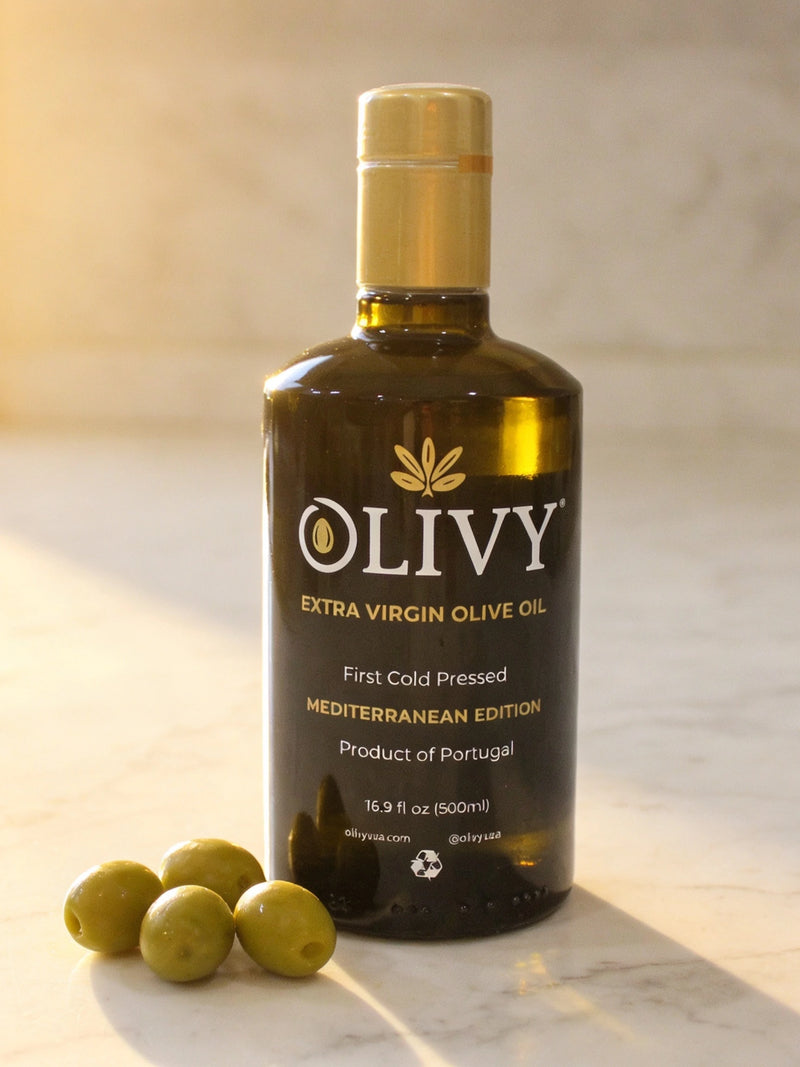
If you'd like a figure you can actually check: Olivy Mediterranean Edition is tested at 439 mg/kg total polyphenols, alongside 0.11% free acidity and 6.2 meq/kg peroxide value, by the Laboratório de Estudos Técnicos at the Instituto Superior de Agronomia, University of Lisbon — and the report for every batch is published with its lot number attached.