Third-Party Tested Olive Oil: What to Look For Before You Buy

Third-party tested olive oil is oil analysed by an independent laboratory with no commercial stake in the result — and the claim is only worth anything if the report is published, names the lab, and covers both chemistry and taste. Almost every premium brand now says some version of "lab tested." Very few will hand you the document. The difference between those two things is the entire subject of this article: what an independent test actually involves, what accreditation to look for, what a real certificate contains, and the five red flags that separate a testing claim from testing evidence.
What does "third-party tested olive oil" actually mean?
It means the oil was analysed by a laboratory that is independent of the producer — a "third party" to the transaction between the brand and you. The phrase carries no certification, no seal and no legal force on its own. It describes who ran the test, not what the test found or whether you can read it.

Three arrangements often get described the same way, and they are not equivalent:
- In-house testing. The producer runs its own analysis, usually at the mill. Often accurate and genuinely useful for production decisions — but it is a first-party claim, and the producer chooses which results leave the building.
- Commissioned third-party testing. The producer pays an independent lab to analyse a sample and receives a report. This is the common meaning of the phrase, and it is a real step up: the lab's reputation rests on the accuracy of the number, not on the oil selling well.
- Certification. A body such as a national council tests and audits against a defined standard and grants a seal. Stronger still, because a third party also decides whether the result passes — but it is scheme-specific and mostly regional.
The useful question is not which label a brand uses. It is whether the report exists in a form you can read, tied to the batch in your hand. Everything below is about telling those apart.
Chemical analysis vs sensory analysis — why both are required
An oil cannot be graded extra virgin on chemistry alone. It must pass a chemical panel and a trained human tasting panel, and failing either one disqualifies it. This surprises most buyers, and it is the single most useful thing to understand about olive oil testing.
The chemical side
Instrument analysis measures things a person cannot perceive: free acidity, peroxide value, the ultraviolet absorbance figures known as K232 and K270, fatty acid profile, and sterol composition. These answer questions about handling, oxidation, and whether the oil has been cut with something else. Free acidity, for instance, records how gently the fruit was picked and how fast it was milled — a measure covered in full in what olive oil acidity actually measures.
The sensory side
Under the International Olive Council's method for the organoleptic assessment of virgin olive oil, a panel of eight to twelve selected and trained tasters assesses each sample blind, in standardised blue glasses that hide the colour. They score defects — fusty, musty, winey, rancid — and positive attributes: fruity, bitter, pungent.
For an oil to be graded extra virgin, the panel's median defect score must be zero and the median fruity score must be above zero. One perceptible defect at the median, and the oil drops a grade no matter how clean its chemistry looks.
This is why chemistry alone is an incomplete answer. Rancidity, in particular, is often detected by a trained panel before the peroxide value crosses its threshold. The two methods catch different failures, which is precisely why the standard requires both.
What makes a laboratory credible: ISO 17025 and IOC recognition
Two credentials matter: ISO/IEC 17025 accreditation from a national accreditation body, and recognition by the International Olive Council. A lab holding both has been independently judged competent and is re-tested every year against samples of known composition.
| Credential | What it verifies |
|---|---|
| ISO/IEC 17025 accreditation | The laboratory's technical competence, method validation, equipment calibration and quality management — assessed by a national accreditation body, not self-declared |
| IOC recognition | That the lab correctly applies the IOC's own analytical methods, confirmed through annual proficiency testing coordinated by the IOC's Executive Secretariat |
| Sensory panel accreditation | Panels are assessed separately under ISO 17025 as well — panellist selection, training, and result reporting are all documented and audited |
The IOC's standardisation unit publishes its recognised laboratories, so a lab name on a certificate can be checked against a list rather than taken on faith. University laboratories and national agronomy institutes are common in this role for a structural reason: their income does not depend on any one producer's result.
None of this requires you to become an expert. It requires the certificate to name the lab at all — which is the first thing many "lab tested" claims quietly omit.
What a real certificate of analysis contains
A genuine certificate identifies the sample, the laboratory, the methods and the date — not just a list of flattering numbers. Here is what to look for, and what each element rules out.
- A batch or lot number. The link between the document and the bottle. Without it, a report describes an unspecified oil the producer once made.
- The harvest date or sampling date. Olive oil changes measurably over time. A report with no date attached could be years old and still technically accurate about a sample that no longer exists.
- The laboratory's name and address. Checkable against the IOC's recognised list, or at minimum against a real institution.
- The analytical methods used. Real reports cite the method for each parameter. This is unglamorous and it is the strongest sign the document came from a lab rather than a design file.
- The full parameter set, including anything that failed. Free acidity, peroxide value, K232 and K270 at minimum. A single number, presented alone, is a selected number.
- The limits alongside the results. A result of 0.24% means little without 0.8% beside it for context.
Most of these are things you notice by their absence. A certificate that names a real lab, a real method, and a real batch is doing something a marketing asset cannot easily imitate.
Five red flags in a third-party testing claim

None of these prove an oil is poor. Each one tells you a claim is weaker than it sounds.
1. "Lab tested" with no report anywhere on the site
The phrase costs nothing to print. Publishing the document costs a producer the ability to be selective about it, which is exactly what makes publication meaningful.
2. A single number with no panel around it
An oil quoted only on acidity, or only on polyphenols, has had one line lifted from a fuller document. The other lines still exist. A related habit — the unquantified adjective — is taken apart in what "low acidity" actually qualifies as.
3. No batch number, or a report that never changes
Olive oil is an agricultural product with a new pressing every year. A brand still displaying one report across multiple harvests is telling you about a past oil, not the current one.
4. Chemistry only, with no sensory result
Since a defect median above zero disqualifies an oil regardless of its chemistry, a producer showing only instrument numbers has shown you half the grading criteria.
5. An unnamed lab, or a testing claim you cannot get a document for
Asking is the whole test. A brand with a good report will usually send it. If a request for a certificate produces a brochure, that is not proof of anything wrong with the oil — but it is the absence of the evidence you asked for, which is worth registering as information.
What we publish, and why
Every Olivy harvest is sampled and analysed by the Laboratório de Estudos Técnicos at the Instituto Superior de Agronomia, University of Lisbon — an independent university laboratory with no commercial interest in what the numbers say. The full report is published, exactly as it comes back, with the batch number that appears on the bottle.
| Parameter | Current harvest | Extra virgin limit |
|---|---|---|
| Free acidity | 0.11% | 0.8% |
| Peroxide value | 6.2 meq/kg | 20 meq/kg |
| Total polyphenols | 439 mg/kg | EU reference point: 250 mg/kg |
The reason for publishing the whole document rather than the best line is simple, and it is not generosity. A number a producer selects is a claim. A document a producer commits to in advance, batch after batch, is something you can hold them to. When 69% of imported "extra virgin" oil sold in California failed to meet extra virgin standards in the UC Davis Olive Center's 2010 analysis, the problem was never that buyers lacked opinions about quality. It was that they had no way to check. The wider version of that check is in why third-party lab reports matter.
Frequently asked questions
What does third-party tested mean for olive oil?
It means an independent laboratory — one with no commercial stake in the outcome — analysed a sample of the oil. The phrase carries no seal or legal force on its own, and it describes who performed the test rather than what was found. It becomes meaningful when the resulting report is published, names the laboratory, and is tied to a specific batch.
Is third-party tested olive oil worth paying more for?
Testing itself costs a producer relatively little. What it signals is a willingness to be checked, and a production process careful enough to survive the check — which is where the cost actually sits. Whether that is worth a premium depends on how much you value being able to verify a claim rather than trust it. If a brand tests but does not publish, you are paying for the claim and not the verification.
What certifications should an olive oil testing lab have?
ISO/IEC 17025 accreditation from a national accreditation body, which verifies technical competence and method validation, and recognition by the International Olive Council, which is confirmed through annual proficiency testing. Sensory panels are separately accredited under ISO 17025. A certificate should name the laboratory so these can be checked.
Can olive oil be extra virgin if it passes chemical tests but fails the taste panel?
No. Under the IOC standard an oil must satisfy both. The sensory panel's median defect score must be zero and its median fruity score above zero. An oil with clean chemistry that a trained panel finds fusty, musty, winey or rancid at the median is graded down to virgin or lower, regardless of its instrument results.
How do I ask a brand for their lab report?
Contact them and ask for the certificate of analysis for the batch code printed on your bottle. A useful reply names the laboratory, covers free acidity, peroxide value and the K-values, and is dated to a harvest. A reply describing quality standards in general terms without attaching a document is an answer of a different kind.
Written by Pedro Borges, Co-Founder of Olivy. Raised in a family where good food was a daily ritual, Pedro brings firsthand knowledge of single-origin olive oil straight from the source. His writing reflects years of working closely with Portuguese producers and a genuine passion for the craft behind every bottle. Every claim here ties to a published lab report or a cited source.
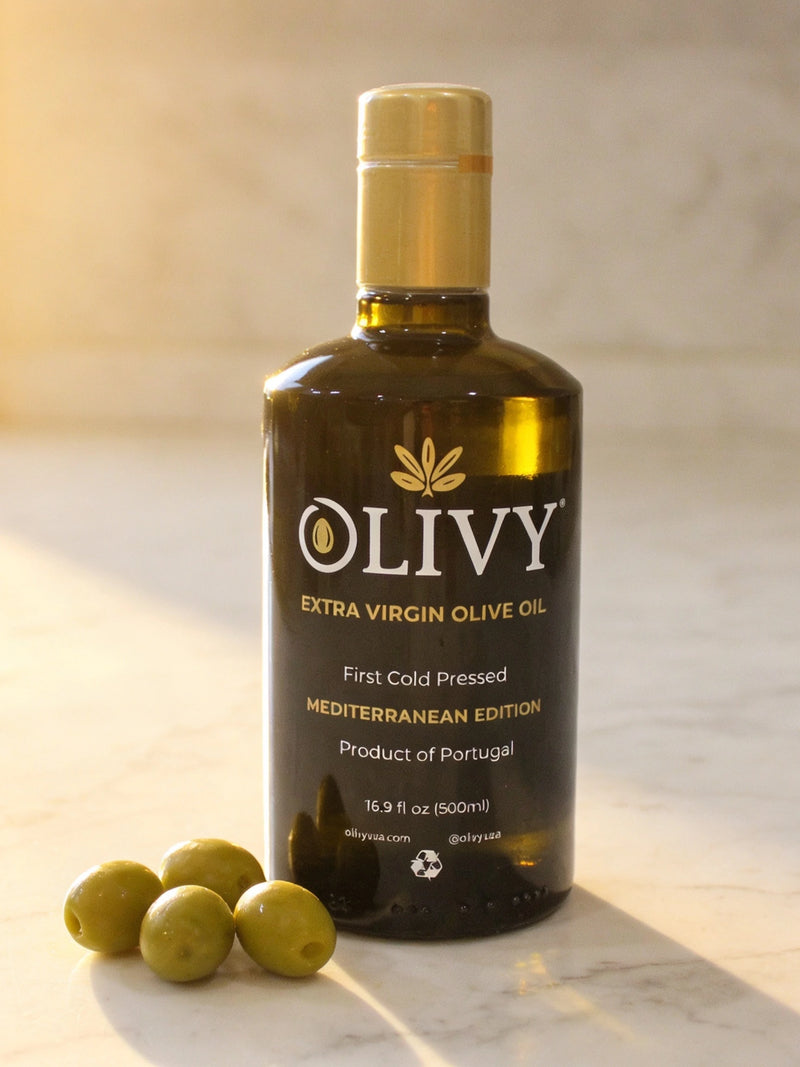
The simplest way to judge a testing claim is to read one. Every Olivy harvest's full lab panel is public, batch codes included, and the Mediterranean Edition ships with the batch number that matches the report.
Sources
- International Olive Council — COI/T.20/Doc. No 15/Rev. 11, Method for the Organoleptic Assessment of Virgin Olive Oil
- International Olive Council — Standardisation and Research Unit (laboratory recognition and proficiency testing)
- International Olive Council — Trade standard applying to olive oils and olive-pomace oils (Rev. 20)
- UC Davis Olive Center — supermarket olive oil analysis (2010)
- Olivy — published lab reports, Instituto Superior de Agronomia, University of Lisbon