Low Acidity Olive Oils: What Qualifies, and How to Verify the Claim

Low acidity olive oils are oils whose free fatty acid content sits well below the 0.8% ceiling that defines extra virgin — in practice, under about 0.3%. There is no legal definition of the phrase itself, which is why it appears on so many bottles and means so little on its own. The number behind it is what matters: free acidity records how gently the fruit was picked and how quickly it was pressed. Below is what actually qualifies as low, how the published standards compare, a four-step way to verify any producer's claim, and the four things a low figure genuinely cannot tell you.
What counts as a low acidity olive oil?
An oil is meaningfully low in acidity when its free acidity measures at or below roughly 0.3%, and exceptionally low below 0.2%. Those are working benchmarks drawn from what careful producers actually achieve, not legal thresholds — because no regulator anywhere defines the marketing phrase "low acidity."

This is the first thing worth understanding, because it explains why the phrase is everywhere. Every oil legally sold as extra virgin is already below 0.8% free acidity under the International Olive Council trade standard. So an oil at 0.79% and an oil at 0.11% can both carry "low acidity" on the label, truthfully, while being seven times apart on the measurement.
A rough set of bands, based on where real oils land:
| Free acidity | What it indicates |
|---|---|
| Below 0.2% | Exceptional handling — early-harvest fruit, sound and unbruised, milled within hours |
| 0.2% – 0.3% | Genuinely low; typical of well-run premium production |
| 0.3% – 0.5% | Good; meets California's stricter mandatory ceiling |
| 0.5% – 0.8% | Legally extra virgin, but the handling was less careful or the fruit less sound |
| Above 0.8% | Cannot be sold as extra virgin |
Read the table as a description of process, not of flavour. Nothing in it tells you how an oil tastes.
How the published acidity standards compare
The 0.8% extra virgin limit is an international floor, and two North American standards set it lower. Knowing which ceiling a producer clears tells you more than the word "low" does.
- IOC and USDA — 0.8%. The international trade standard for extra virgin, mirrored by the USDA's voluntary grade standards. Paired with a peroxide ceiling of 20 meq/kg.
- California Department of Food and Agriculture — 0.5%. Mandatory since 2014 for handlers producing 5,000 gallons or more from California-grown olives, with required testing before sale. It caps free acidity at 0.5% and peroxide at 15 meq/kg.
- California Olive Oil Council certification — 0.5%. A voluntary seal on top of that, requiring 100% California-grown fruit plus annual chemical and sensory testing.
The pattern is consistent: every body that has revisited the question has tightened the number, not loosened it. That is a reasonable signal that 0.8% is a legal minimum rather than a quality target.
One thing the standards share, and it matters: free acidity alone never decides a grade. An oil must also pass a trained sensory panel with zero defects. Chemistry and taste are checked separately, and an oil can clear one while failing the other.
Why low acidity olive oils are usually better made
Free acidity counts fatty acids that have broken loose from their triglycerides, and that breakage is caused almost entirely by damage to the fruit. So the number works backwards as a record of the harvest.
Four things push it up, and all four happen before the oil is in a bottle:
- Bruising. Fruit beaten from trees or piled deep in bins arrives damaged, and every bruise is where enzymes begin splitting the fat molecules.
- Delay before milling. Olives start degrading the moment they leave the tree. Fruit that waits days in a warm yard ferments; milling within hours is the difference between a tenth of a percent and several times that.
- Over-ripe fruit. Softer olives damage more easily and carry more enzymatic activity, which is one reason late-harvest oils tend to run higher.
- Pest damage. The olive fruit fly punctures the fruit and opens it to fermentation, lifting regional averages in a bad infestation year regardless of picking care.
None of those are things a producer can fix after the fact. You cannot lower free acidity by filtering, blending down, or storing an oil better — it is set at the mill. That permanence is precisely what makes it useful. A very low figure is expensive to achieve and impossible to fake without simply testing a different oil.
The full chemistry, including why the word "acidity" is misleading in the first place, is laid out in what olive oil acidity actually measures.
How to verify a low acidity claim in four steps
A low acidity claim becomes evidence the moment a specific number, a batch, an independent lab, and a readable report sit behind it — and stays marketing until then. Four steps, none of which need any expertise:
1. Ask for the number, not the adjective
"Low acidity" is a category description. "0.24% free acidity" is a measurement. If a producer publishes the phrase but not the figure, the figure is the thing to request. Most brands that have a good number are happy to give it, because it took work to get.
2. Check which batch and harvest it describes
Because acidity is fixed at pressing, a figure with no harvest attached could belong to any year that producer has ever made oil. A number tied to a batch code and a harvest date describes the bottle you are actually holding. One without either describes nothing in particular.
3. Find out who ran the test
A figure a producer generates about itself is a claim. A figure from an independent, accredited laboratory is evidence. The distinction is not about honesty — plenty of in-house testing is accurate — it is about who bears the cost of being wrong. Ours is run by the Laboratório de Estudos Técnicos at the Instituto Superior de Agronomia, University of Lisbon, which has no commercial stake in the result.
4. Read the whole panel, not the one number
A real report lists free acidity alongside peroxide value and the K-values. A producer who publishes only the flattering line has chosen which number you get to see. Asking for the full document is the single most useful thing a buyer can do, and it is covered in more depth in why third-party lab reports matter.
If a request for a report is met with a brochure, that is itself an answer. Not proof of a bad oil — but the absence of the evidence you asked for.
Four things low acidity olive oils don't tell you
A low acidity figure describes handling at harvest and nothing else. Honest reading means knowing the edges of what it covers.

- It does not tell you how the oil tastes. At these concentrations free fatty acids have no flavour or aroma at all. Trained sensory panellists cannot detect free acidity, and neither can you — the word "acidity" is chemistry, not the sourness of a lemon.
- It does not tell you the polyphenol count. Acidity and polyphenols are produced by different things and measured separately, so a low figure implies nothing about antioxidant content. That link is taken apart properly in does low acidity olive oil have more polyphenols.
- It does not tell you how the oil has been kept since. Free acidity barely moves in the bottle. Peroxide value is the number that climbs with light, heat and air — which is why a fresh-tasting oil and a tired one can share the same acidity figure.
- It does not tell you the oil is defect-free. Grading requires passing a sensory panel too. An oil can clear every chemical threshold and still be rejected for a musty or fusty flavour a panel can identify.
This is the honest limit of the measurement, and stating it is not a hedge. A number that answers one question well is more useful than a number asked to answer four.
A worked example: reading one real panel
Abstract thresholds are easier to use against a real report, so here is ours, published in full with the batch number that appears on the bottle.
| Measurement | Our current harvest | Extra virgin limit | What it records |
|---|---|---|---|
| Free acidity | 0.11% | 0.8% | How gently the fruit was handled before milling |
| Peroxide value | 6.2 meq/kg | 20 meq/kg | How well the oil has been protected since pressing |
| Total polyphenols | 439 mg/kg | EU reference point: 250 mg/kg | Antioxidant content — a separate question entirely |
0.11% is roughly seven times below the extra virgin ceiling and under half of California's stricter 0.5% standard. It comes from early-harvest, first cold-pressed fruit from a single PDO Trás-os-Montes grove in northern Portugal, milled fast. The peroxide figure of 6.2 meq/kg is a different claim — that the oil has been kept away from heat and light since, helped by early pressing and dark glass. And 439 mg/kg answers the polyphenol question that acidity cannot.
Three numbers, three separate questions. That is the shape of a panel worth reading, and the reason we publish the whole document rather than the best line from it. The same logic applied to a supermarket label — harvest dates, origin, what to ignore — is in how to read an olive oil label.
Frequently asked questions
What is considered low acidity in olive oil?
There is no legal definition, but in practice free acidity at or below 0.3% is genuinely low, and below 0.2% is exceptional. Every oil sold as extra virgin is already below 0.8% under the IOC standard, so the phrase alone does not distinguish much — the specific figure does. California's mandatory state standard sets a tighter ceiling of 0.5%.
Are low acidity olive oils better?
Better made, usually yes. Free acidity records how gently the olives were picked and how quickly they were pressed, and a very low figure is difficult and expensive to achieve. But it is a handling measure, not a complete quality verdict: it says nothing about flavour, polyphenol content, or how the oil has been stored since bottling. Read it alongside peroxide value, the K-values and a harvest date.
Can you taste low acidity in olive oil?
No. At concentrations well under one percent, free fatty acids have no flavour or aroma, and even trained sensory panellists cannot detect them. Low acidity oils often do taste fresher, but that is because the careful handling which produces a low figure also avoids the defects a panel can taste — the acidity itself is not what you are tasting.
Do low acidity olive oils have more polyphenols?
Not necessarily. Acidity and polyphenol content are produced by different factors and measured separately on a lab panel. Early harvesting tends to improve both at once, which is why they often appear together, but one does not cause the other. An oil can be very low in acidity and modest in polyphenols, or the reverse.
How can I check an olive oil's acidity myself?
Free acidity is measured by titration in a laboratory, so there is no reliable home test — the refrigerator test and similar shortcuts do not measure it. The practical route is to ask the producer for the certificate of analysis for the batch you bought, and check that it names an independent lab, a batch code and a harvest date.
Written by Pedro Borges, Co-Founder of Olivy. Raised in a family where good food was a daily ritual, Pedro brings firsthand knowledge of single-origin olive oil straight from the source. His writing reflects years of working closely with Portuguese producers and a genuine passion for the craft behind every bottle. Every claim here ties to a published lab report or a cited source.
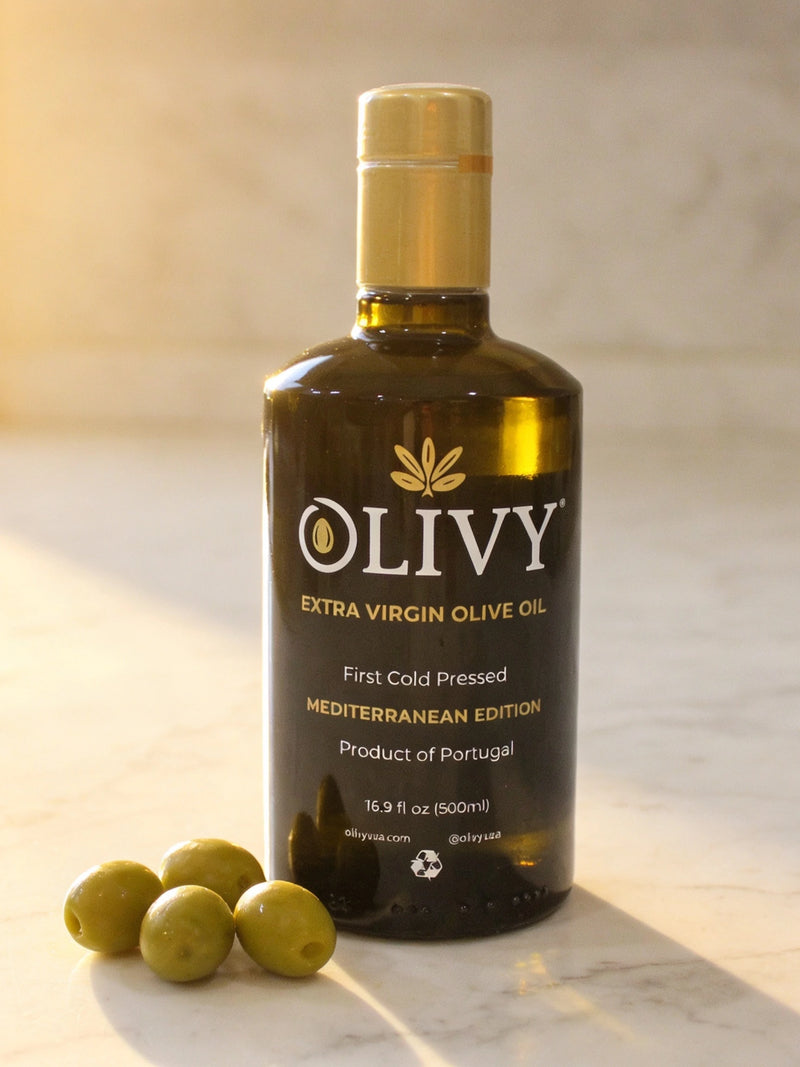
If you want to see what a verified number looks like from the other side, every Olivy harvest's full lab panel is public — batch codes included — and the Mediterranean Edition ships with the batch number that matches the report.
Sources
- International Olive Council — Trade standard applying to olive oils and olive-pomace oils (Rev. 20)
- USDA AMS — Olive Oil and Olive-Pomace Oil Grades and Standards (voluntary)
- California Department of Food and Agriculture — Grade and Labeling Standards for Olive Oil (0.5% free acidity ceiling)
- California Olive Oil Council — certification program and seal requirements
- Olivy — published lab reports (0.11% free acidity, 6.2 meq/kg peroxide, 439 mg/kg polyphenols, University of Lisbon)