Olive Oil Polyphenol Content Chart: What Counts as Low, Typical and High (mg/kg)

There is no official scale for low, typical and high polyphenols in olive oil. What exists is one regulatory reference point, 250 mg/kg of hydroxytyrosol and its derivatives under EU Regulation 432/2012, and a handful of published surveys whose results run from roughly 40 to 530 mg/kg depending on which oils were tested and how. This olive oil polyphenol content chart puts those numbers side by side with their sources, then adds plain working bands for reading a result. The bands are our own shorthand drawn from the studies, not a standard anyone has adopted, and every figure comes with the method behind it, because the method decides whether two numbers can be compared at all.
The olive oil polyphenol content chart
Two tables. The first holds the reference points and the measurement range of the standard method. The second holds what published surveys of real bottles have found. Units are mg/kg, which is the same as parts per million (ppm). If a source reported something else, the conversion is shown.
Reference points
| Reference point | What it covers | Figure | Method and unit |
|---|---|---|---|
| EU Regulation 432/2012 labeling condition | Hydroxytyrosol and its derivatives | 250 mg/kg | The condition is at least 5 mg per 20 g of oil. 5 mg divided by 20 g is 250 mg/kg. |
| International Olive Council method, working range | Biophenolic compounds in olive oil | 30 to 800 mg/kg | HPLC, UV detection at 280 nm, reported as tyrosol equivalents |
What published surveys found
| Survey | Oils | Result | Method and unit |
|---|---|---|---|
| Comprehensive analysis of polyphenols in 55 extra virgin olive oils | 55 oils, 9 countries, four continents | 40 to 530 mg/kg total phenols | HPLC with an electrochemical array detector, gallic acid equivalents |
| Wang et al., 2022, Chinese Journal of Oil and Fat | 28 commercial oils from China | about 64 to 307 mg/kg | HPLC following the International Olive Council recommendation |
| Caporaso et al., 2015, Journal of Food Composition and Analysis | 32 extra virgin oils from the Italian retail market | Only 3 of 32 above 250 ppm | ppm, as reported in the study summary |
| University of Athens with the UC Davis Olive Center, 2014 | 110 extra virgin oils from Northern California supermarkets and local stores | 56 of 110 met the 250 mg/kg criterion | Nuclear magnetic resonance (NMR) |
| Lino et al., 2024, Foods | Sicilian oils from three cultivars | about 470 to 890 mg/kg | Reported as 9.4 to 17.8 mg per 20 g of hydroxytyrosol and derivatives, multiplied by 50 |
| Shendi et al., 2018, OCL | One oil, stored 12 months at 18 to 24 °C in amber glass | 343 down to 252 ppm total phenols | Same oil measured at the start and the end |
Read across the second table and the spread is the story. Oils measured by similar methods land at about 64 in one study and about 890 in another, and one survey of shelf bottles found nearly all of them under the 250 line while another found about half over it. Those studies used different oils, different years and different methods, which is exactly why no single number can stand in for "typical."
Working bands: low, typical and high

People ask for a simple scale, so here is one, with its limits stated up front. These bands are an editorial reading of the surveys above. They are for asking better questions of a label, not for grading an oil. Place a number on them only when you know how it was measured.
| Band | Roughly (mg/kg) | How to read it | Where the published figures sit |
|---|---|---|---|
| Low | Under 150 | A mild oil, an older oil, or one pressed from ripe fruit. Not a defect on its own. | The lowest ends of the surveys: 40 and about 64 mg/kg |
| Moderate | 150 to 250 | Below the EU reference point. | 29 of 32 Italian retail oils fell under 250 ppm (32 minus the 3 above it) |
| Above the reference point | 250 to 400 | Clears the EU labeling condition if the figure is hydroxytyrosol and derivatives. | 56 of 110 California oils met 250; the top of the Chinese survey was about 307 |
| Upper range | Above 400 | The upper part of what the surveys report. Needs a report to back it. | Up to 530 in the 55-oil survey; about 470 to 890 in the Sicilian oils; 800 is the top of the IOC method's working range |
A few honest caveats. The 250 line belongs to one specific measurement, hydroxytyrosol and its derivatives, while several of the surveys report total phenols by other methods. The California result used NMR, not HPLC. And the Sicilian figures are converted from a per-20-gram claim value, not measured in mg/kg directly. The bands are a map, not a ruler.
Who defines low, typical and high?
Nobody does, and that surprises people. The pass or fail tests that make an oil extra virgin are free acidity, peroxide value, UV absorbance and a trained tasting panel. Polyphenol count is not one of them. An oil can meet every legal criterion for extra virgin and still sit anywhere on the chart above.
The one official number is the 250 mg/kg figure, and it is not a grade. It falls out of an EU labeling condition: an olive oil may carry the regulation's claim only if it contains at least 5 mg of hydroxytyrosol and its derivatives per 20 g. Five milligrams over twenty grams is 250 milligrams per kilogram. The EUROLIVE researchers who produced the underlying work said, as Olive Oil Times reported in 2014, that all forms in which tyrosol and hydroxytyrosol are present, free and bound, must be measured for compliance. That is a narrower and more demanding measurement than a simple total.
For the full picture of what that threshold means, see our guide to what mg/kg polyphenols mean on an olive oil label.
Why two labs report different numbers
Two honest laboratories can measure the same oil and report different totals. Usually nobody has made a mistake. They have answered slightly different questions.
HPLC, the International Olive Council method. Method Doc. No 29 separates the oil's phenolic compounds by liquid chromatography, detects them by UV absorbance at 280 nm and adds up the peaks of more than a dozen identified compounds, including hydroxytyrosol, tyrosol, the oleuropein and ligstroside derivatives, lignans, flavonoids and phenolic acids. Everything is converted to tyrosol equivalents and reported in mg/kg across a working range of 30 to 800.
Folin-Ciocalteu, the colorimetric assay. This one measures how strongly a sample reduces a reagent, then expresses the result "as" a reference compound the lab chooses, commonly gallic acid or caffeic acid. A study of 88 extra virgin oils run by both approaches, Alessandri, Ieri and Romani (2012), found that the colorimetric result tracks diphenols reliably but does not follow lignans and flavonoids, and advised caution for oils with very different phenolic profiles.
NMR. A newer approach that measures individual compounds directly. The researchers behind the California survey described it as promising but said more replication and standardization were needed.
The reference compound matters more than most people expect. The Aroma Dictionary's olive oil chemistry writer, in a piece on why total polyphenol results differ, argues that any total polyphenol figure has to name the compound used for its calibration curve to mean anything, and cites a comparison in which the IOC method read on average 67 percent higher than the colorimetric method calibrated with caffeic acid. Treat that as one reported comparison, not a universal conversion. It is a good reminder that "as caffeic acid" and "as tyrosol equivalents" are different rulers.

| If a result says | It means |
|---|---|
| mg/kg or ppm | The same thing. Milligrams per kilogram of oil. |
| mg per 20 g | Multiply by 50 to get mg/kg. |
| "as caffeic acid" or "as gallic acid" | A colorimetric total, calibrated against that compound. |
| "tyrosol equivalents" or "IOC method" | An HPLC total, calibrated the International Olive Council way. |
| "hydroxytyrosol and derivatives" | The narrower figure the EU labeling condition refers to. |
How to read a polyphenol number on a bottle
When a bottle or a product page gives a polyphenol figure, five questions turn it from a claim into something you can use:
- What is the unit? mg/kg and ppm are interchangeable. Anything else needs converting.
- What is it measured as? A method and a reference compound should be named. If neither is, the number cannot be placed on any chart.
- Which harvest and which batch? A figure from a past harvest describes that oil on that day, not the bottle in your hand.
- Who ran the test? An independent laboratory is a different thing from a producer's own measurement.
- Can you read the report? A published report is the difference between a number and a receipt. Our guides on what lab tested olive oil actually involves and how third-party testing works go through what to look for.
What moves the number
Even with the method held constant, a polyphenol figure moves for reasons that have nothing to do with the lab.
- Cultivar and harvest timing. In the Sicilian study, the authors concluded that cultivar and harvest period were the primary factors shaping the oil's phenolic content, and that milling method played a secondary role. Fruit picked green and early tends to carry more. We cover the trade-off in early harvest versus late harvest olive oil.
- Time on the shelf. In the Turkish storage study, total phenols fell from about 343 to 252 ppm over a year, a drop of 26 percent, even in amber glass at ordinary room temperature. Phenolics are used up as they protect the oil.
- Heat, light and air. The California researchers listed the type of bottle, time on the shelf, and conditions in the warehouse or in transport among the factors that change phenolic levels. Our guide to how to store olive oil covers the part you control.
- Sampling. The same California researchers cautioned that their results should not be read as a promise that a specific brand will contain the same amount when bought at a different time or in a different place. A survey is a snapshot of bottles, not a statement about a brand.
This is why a chart can orient you but cannot tell you what is in the bottle you are holding. Only a report for that harvest can.
Where Olivy's published figure sits
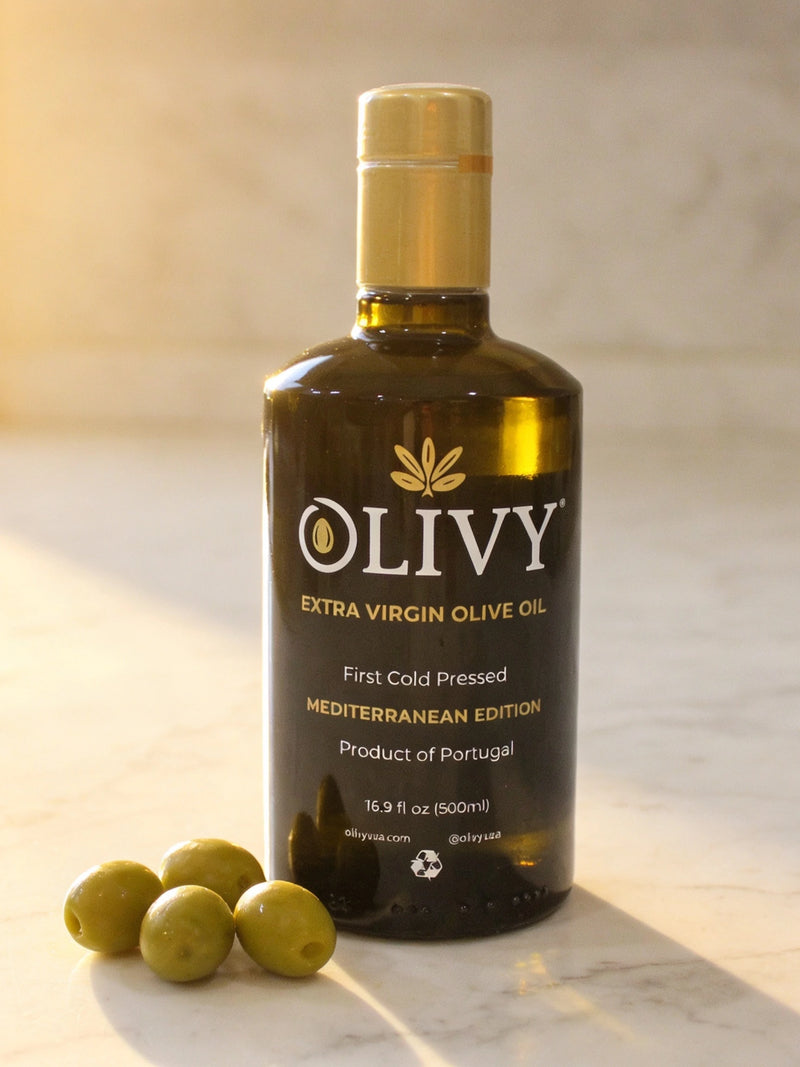
Olivy Mediterranean Edition is independently tested at 439 mg/kg total polyphenols. That figure comes from lab batch 259.00/25 (Lote 2). The laboratory, the Laboratório de Estudos Técnicos at the Instituto Superior de Agronomia, University of Lisbon, reports it as 439.3 ppm expressed as caffeic acid, using its internal method. The report states that this method falls outside the laboratory's accreditation scope. We would rather say that here than leave you to find it in the PDF.
That detail is exactly the one this post has been building toward. 439 mg/kg as caffeic acid by a colorimetric internal method is a different measurement from the 250 mg/kg hydroxytyrosol-and-derivatives line, and from the HPLC ranges in the survey table. So we show them side by side as context and do not claim that 439 beats 250. If you place 439 on the chart, it lands in the upper part of the published figures, with the caveat that it is not the same ruler.
The other figures on our proof page come from a different batch report, 866.00/25 (PDO Trás-os-Montes), and each one is attributed to its own batch. Both lab reports are published in full, so you can check the method line yourself. Olive oil is not the only place these compounds turn up, either; the live guide to foods high in polyphenols lays out the wider list.
A one-page version to keep
The two tables above are plain text, so they print cleanly from your browser. If you want something to pin inside a cupboard door or keep on your phone, save the one-page chart under the bands heading. It carries the four working bands and the reminder that matters most: a number without a method is not comparable.
If you are shopping, a short version fits on the back of a receipt. Ask for the number, the method, the batch and the report. An oil that can answer all four is usually an oil that wants you to check.
Frequently asked questions
What is a good polyphenol level for olive oil?
There is no official good level. The only formal reference point is the EU's 250 mg/kg labeling condition for hydroxytyrosol and its derivatives. Published surveys of real bottles range from roughly 40 to 530 mg/kg, and individual studies report oils well above and well below 250.
Is 250 mg/kg low or high?
Neither. It is the threshold for using one specific EU claim, not a grade. In one survey of 32 Italian retail oils only 3 were above 250 ppm, while in a survey of 110 California oils 56 met it, so where 250 sits depends on which oils you look at.
Are ppm and mg/kg the same?
Yes. One part per million of oil by weight is one milligram per kilogram, so a result in ppm can be read directly as mg/kg.
Why does my olive oil's number differ from a number in a study?
Because of method, calibration compound, harvest and storage. A colorimetric total expressed as caffeic acid and an HPLC total expressed as tyrosol equivalents are different measures, and the same oil can also lose phenolic content as it ages.
Do olive oil polyphenols decrease over time?
Yes. In one 12-month study at room temperature in amber glass, total phenols fell from about 343 to 252 ppm, a decrease of 26 percent. Harvest date, a cool dark cupboard and finishing a bottle within a few months of opening all help preserve a measured number.
Written by The Olivy Kitchen. The Olivy Kitchen is Olivy's in-house editorial team, writing about single-origin extra virgin olive oil, how it's tested, and how to use it. Every claim is tied to a published lab report or a cited source.
If you would rather compare olive oils on a published report than an adjective: Olivy Mediterranean Edition is single-origin, PDO Trás-os-Montes, early-harvest and first cold-pressed, and its lab reports are public.