What Makes a Premium Olive Oil Worth $45+

A premium olive oil costs what it costs mostly because of yield: it takes roughly five kilos of early-picked olives to fill one 500 ml bottle, and early-picked olives give up only about 12–16% of their weight as oil. Everything else — hand-harvesting, milling within hours, dark glass, independent lab testing, origin certification — sits on top of that arithmetic. Below is a real published cost breakdown from a producer, what pushes a bottle past the $45 mark, what you're genuinely not paying for, and the honest cases where a premium oil isn't worth it to you.
It starts with yield

An olive is mostly water and pulp. How much oil you get out of it depends heavily on when you pick it — and that's the decision that sets the price of everything downstream.
Leave the fruit on the tree until it's fully ripe and black, and you get more oil per kilo. You also get less of the phenolic compounds, because those decline as the fruit matures, and an oil that's milder and less stable over time. Pick it green and early and you get an oil that's bitter, peppery, high in polyphenols and slow to oxidize — and considerably less of it. A Spanish producer publishing its own numbers puts early-harvest oil yield at 12–16%, and roughly 5 kg of olives per 500 ml bottle.
That's the whole trade. You're not paying a premium for a better marketing story; you're paying for the grower's decision to take a smaller crop in exchange for a better oil. We've written separately about what that timing does to the chemistry in early harvest versus late harvest olive oil.
Where the money actually goes
Cost breakdowns for olive oil are rarely published, so this one is worth looking at closely. These are the same Spanish producer's stated figures, per 500 ml bottle, in euros:
| Line item | Stated cost per bottle |
|---|---|
| Olives (~5 kg, at €1.03–€2.10/kg farmgate, 2023/24 campaign) | ~€5–10 |
| Milling, cold extraction, lab analysis and quality control | ~€2 |
| Dark glass bottle | ~€1 |
| Box and packaging | ~€0.50 |
| Transport and storage | ~€0.50 |
| Tax / VAT | ~€1.50 |
| Producer profit | ~€1 |

Two things worth noticing. The fruit is by far the largest line — which is why olive oil prices track harvests so tightly, and why a drought in Andalusia shows up on a shelf in Ohio. And the producer's own margin is the smallest line on the list. When people assume a premium olive oil is mostly markup, this is the arithmetic that says otherwise, at least at the producer end.
Those are one Spanish producer's numbers at a European retail price, not a universal template and not Olivy's cost sheet. They're useful as a shape rather than a total.
What pushes a bottle above that
Between that breakdown and a $45 bottle sit a handful of specific, checkable choices. Each one costs real money and each one is optional — which is exactly why they're worth asking about.
Single-grove sourcing instead of blending
Most olive oil is blended — different groves, sometimes different countries, combined to hit a consistent flavor and a lower cost. Buying from one estate means accepting one estate's harvest, good year or bad, with no blending to smooth it out. It's more expensive and less flexible, and it's the only way a bottle can be traced back to actual trees. Ours comes from PDO Trás-os-Montes in northern Portugal.
Independent lab testing, per batch
Sending every harvest and every batch to a third-party laboratory and publishing the results is a recurring cost with no marketing shortcut. It's also the only thing that converts "extra virgin" from a claim into a documented result — free acidity, peroxide value, polyphenols, all measured by someone with no stake in the answer. Our own lab reports are published per batch, with the lot number attached. There's more on what to look for in third-party tested olive oil.
Protected designation of origin
A PDO/DOP registration isn't a badge you buy. It requires the grove to sit inside a defined region, follow the region's rules on varieties and production, and submit to inspection — a compliance overhead that a generic "Product of Spain" bottle simply doesn't carry. We covered how the certification works in what DOP-certified olive oil means.
Speed and cold extraction
Getting fruit from tree to mill within hours requires the mill to be near the grove and the harvest to be scheduled around it. Every hour olives sit in a crate, fermentation starts and free acidity climbs. Ours tested at 0.11% — roughly seven times below the 0.8% limit for extra virgin — which is what fast, cold handling looks like as a number.
What you're not paying for
Worth saying, since this is where premium food pricing often earns its skeptics:
- Not a heavier bottle. Dark glass costs about a euro and exists to keep light out, not to feel expensive. It's a functional choice that happens to look nice.
- Not the word "artisanal." There is no standard behind it. Nobody audits it.
- Not a higher polyphenol number in isolation. A large figure with no harvest year, no lab and no method behind it is a design element. We went through how to read those claims in our roundup of high-polyphenol brands.
- Not, in a direct-to-consumer bottle, three layers of middlemen. Selling direct removes distributor and retailer margin — which is part of how a small producer can put more of the price into the oil rather than the shelf.
The per-tablespoon math
Price per bottle is a bad unit for something you use a spoonful at a time. A 500 ml bottle holds roughly 33 tablespoons. At $44.99, that's about $1.35 a tablespoon.
For context, the EU's reference intake for its olive oil polyphenol labeling rule is 20 g of oil a day — a little over a tablespoon. So a bottle used as a finishing oil, rather than as the fat you fry in, lasts a household a couple of months and costs roughly the price of a coffee per week.
That framing only works if you actually use it as a finishing oil. Cook with a $45 bottle at high heat and you're paying a premium for phenolic compounds you're destroying on the way to dinner — which is a real way to waste money, and one no brand is going to tell you about.
When a premium olive oil isn't worth it
- If it's your only oil. A household that fries, roasts and dresses out of one bottle should not be buying a $45 one. Keep a decent everyday oil for heat and a small good bottle for finishing.
- If you don't like assertive oil. High-polyphenol oil is bitter and peppery by definition. If that's not a flavor you enjoy, paying more to get more of it is backwards.
- If it'll sit open for a year. Phenolics decline once air gets in. A premium oil you finish in two months delivers what you paid for; the same bottle stretched over a year doesn't.
- If the brand won't show you anything. Price is not evidence. A $45 bottle with no harvest date, no origin more specific than a country, and no lab report is asking for trust it hasn't earned — at which point you're paying premium money for an ordinary claim.
Frequently asked questions
Why is premium olive oil so expensive?
Mostly yield. Early-picked olives give roughly 12–16% of their weight as oil, so it takes around 5 kg of fruit to fill a 500 ml bottle, and the fruit is the largest single cost in the bottle. Hand-harvesting, fast cold milling, dark glass, independent lab testing and origin certification add to it, but the arithmetic of the harvest sets the floor.
How many olives are in a bottle of olive oil?
For an early-harvest oil, roughly 5 kg of olives per 500 ml bottle, according to one producer's published figures. Later-harvest fruit yields more oil per kilo, so the same bottle takes fewer olives — and delivers fewer polyphenols.
Is expensive olive oil actually better?
Not automatically. Price correlates with production choices that tend to produce better oil, but it also correlates with packaging and marketing. What distinguishes the two is documentation: a harvest date, a specific origin, and a published lab report with a named laboratory. Without those, a high price is just a high price.
How long does a $45 bottle of olive oil last?
Used as a finishing oil at around a tablespoon a day, a 500 ml bottle lasts roughly a month; used more sparingly, two or more. Once opened it's best finished within a few months, since air and light degrade the phenolic compounds you paid for.
Should I cook with premium olive oil?
You can, but it's an expensive way to use it. Heat degrades the polyphenols that make a high-phenolic oil worth its price. Most people get better value keeping a moderate everyday oil for cooking and using the premium bottle raw — on finished dishes, bread, salads and soups.
Written by The Olivy Kitchen. The Olivy Kitchen is Olivy's in-house editorial team, writing about single-origin extra virgin olive oil, how it's tested, and how to use it. Every claim is tied to a published lab report or a cited source.
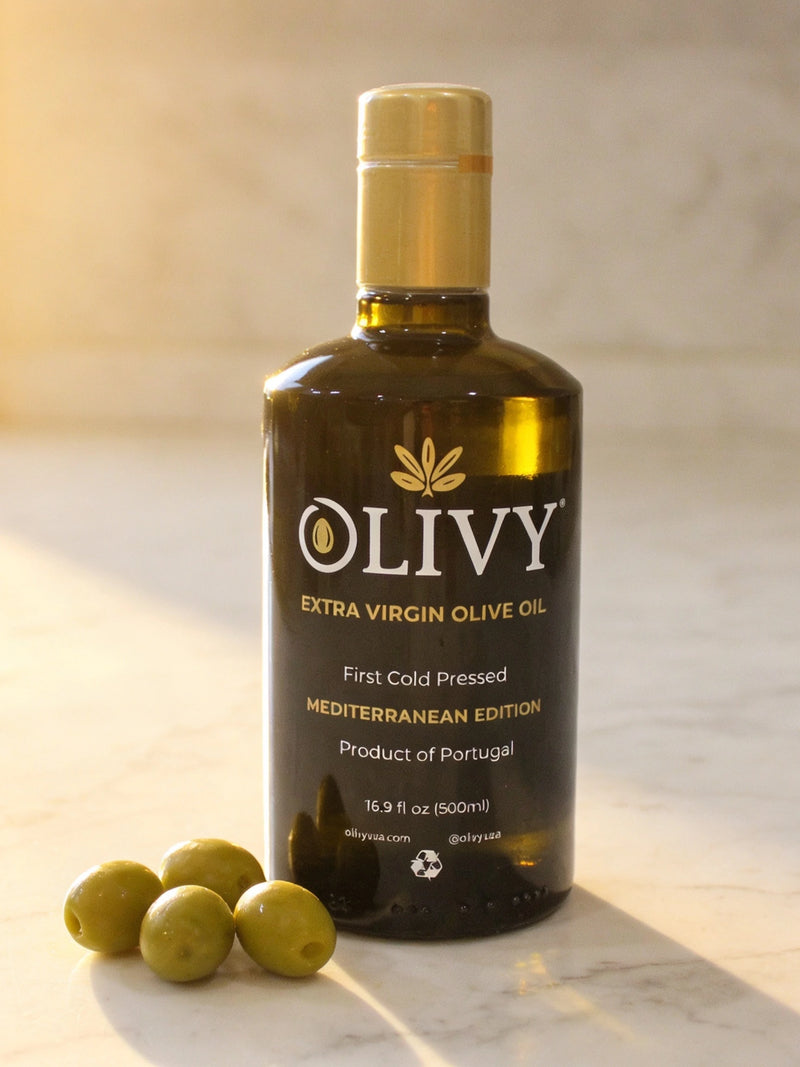
If you want to see the receipts behind one $45 bottle: Olivy Mediterranean Edition is single-origin from PDO Trás-os-Montes, tested at 0.11% acidity, 6.2 meq/kg peroxide and 439 mg/kg polyphenols by an independent university laboratory, with every batch's report published.